
What Is WDM? Benefits for Modern Network Infrastructure
Need more bandwidth without the cost of new fiber? What is WDM? Wavelength Division Multiplexing transmits multiple data streams over one fiber using different light wavelengths. Explore its mechanics and applications with Axclusive below.
What is Wavelength Division Multiplexing (WDM)?
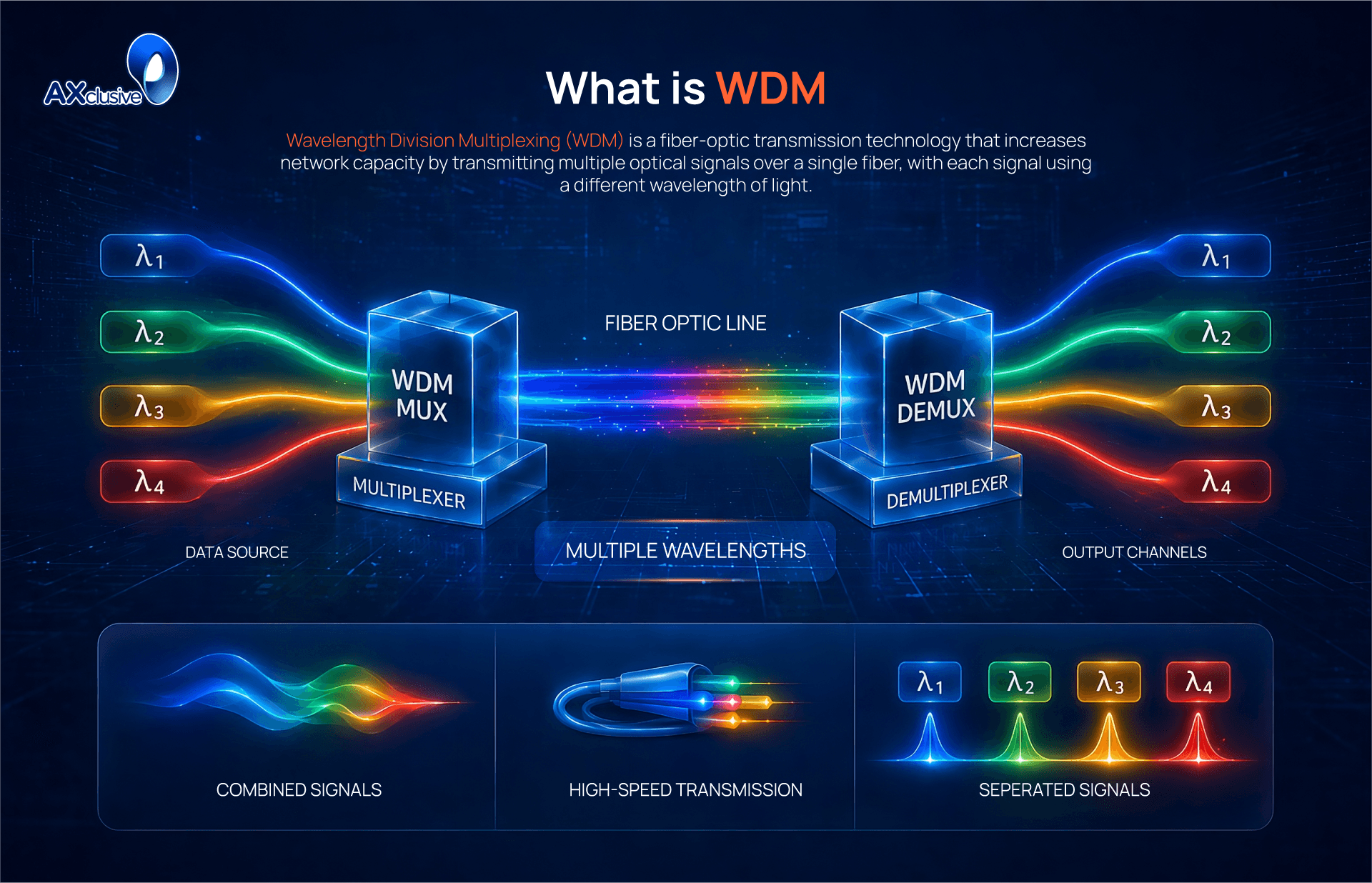
Wavelength Division Multiplexing (WDM) is a technical method used to increase the data capacity of existing fiber optic cables. It works by combining multiple optical signals onto a single strand of fiber using different wavelengths of laser light. Each wavelength carries its own independent data stream. This process requires a multiplexer to combine signals at the transmission point and a demultiplexer to separate them at the receiving end.
By using WDM, network operators scale bandwidth significantly without the high cost of installing new physical fiber infrastructure. It effectively transforms a single physical link into a high-capacity, multi-channel transport system.
Practical Applications of WDM in Modern Networks
Wavelength Division Multiplexing (WDM) technology has transitioned from expensive carrier-grade infrastructure to an accessible solution for private enterprises. Modern businesses use WDM to maximize existing fiber assets without the prohibitive cost of laying new cables. This optical networking technique is essential for environments requiring high capacity and low latency. By assigning different data streams to specific light wavelengths, organizations can create multiple virtual lanes on a single glass strand.
Modern network architects deploy WDM across several critical sectors:
Data Center Interconnect (DCI): Large organizations distribute workloads across multiple physical sites for redundancy. WDM allows these facilities to synchronize massive datasets in real-time. It provides the high-speed "highway" needed for synchronous data replication and cloud workload mobility between geographically separate data centers.
Metro Access Networks: Service providers use WDM to aggregate traffic from various business customers within a city. This application allows them to offer dedicated, high-capacity channels to individual clients while sharing the same physical fiber path. It ensures that the peering networking points between local ISPs remain efficient and uncongested.
Enterprise Campus Connectivity: Hospitals, universities, and large corporate campuses utilize WDM to link separate buildings. This eliminates the need for expensive leased lines from external carriers. By owning the hardware, the enterprise maintains total control over its bandwidth and security.
ISP Backhaul and 5G Infrastructure: Telecommunication providers rely on WDM to carry 5G cell tower traffic back to the core network. As mobile data usage increases, WDM allows providers to scale their backhaul capacity instantly by adding new wavelengths rather than digging new trenches.
High-Frequency Trading and Finance: Financial institutions require the lowest possible latency. WDM minimizes signal delay by providing direct, point-to-point optical paths. This is vital for peering in networking environments where every millisecond affects transaction success.
Key Types of WDM Technologies
Network operators use two primary variations of WDM to increase fiber capacity without installing new physical cables. These technologies differ in wavelength spacing and laser precision. The best choice depends on your specific distance and budget constraints.
CWDM
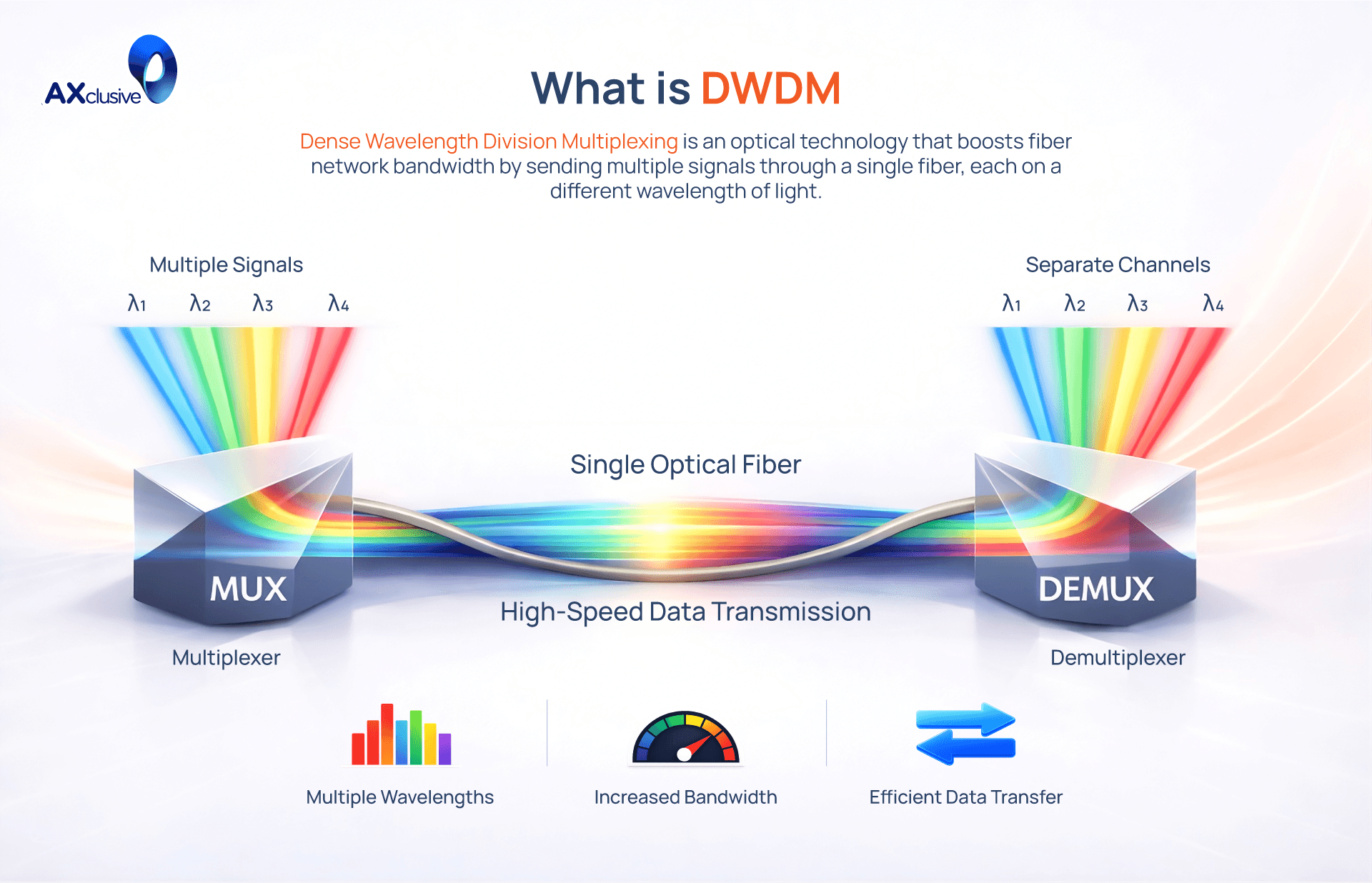
Coarse Wavelength Division Multiplexing serves as the cost effective option for metropolitan networks. It utilizes wide gaps between light signals to allow for less expensive hardware and uncooled lasers. Most CWDM systems support up to 18 channels. This technology is ideal for distances under 80 kilometers where extreme density is not required.
DWDM
Dense Wavelength Division Multiplexing provides the high capacity needed for core network infrastructure. It packs wavelengths very tightly to create dozens of separate data lanes. A single fiber can support 80 or more channels using this method. You should choose DWDM for long distance transit or when your network requires massive terabit speeds.
Benefits of Using WDM in Network Infrastructure
Wavelength Division Multiplexing (WDM) transforms a single fiber strand into a high-capacity data highway. It serves as the primary tool for scaling fiber networks without the need for new construction. Organizations use WDM to meet massive bandwidth demands efficiently. This technology is essential for handling the heavy data exchange found in peering networking. By using different light colors to separate data, WDM increases the inherent value of your physical infrastructure.
Ultra-Large Data Capacity: WDM systems support extreme data rates. You can transmit 100G or 400G signals over a single glass strand. This capacity is vital for data centers and cloud providers. It ensures the network handles peak loads without slowing down. A standard peering definition involves the direct exchange of traffic, and WDM provides the high-speed throughput needed to make those connections viable.
Non-Disruptive Network Expansion: You can add new channels to a WDM link easily. This process does not require you to shut down current traffic. This flexibility allows your business to grow its bandwidth as needed. You simply plug in a new transceiver and connect it to an open port on the multiplexer. This makes peering in networking much more scalable and responsive to sudden growth.
Protocol Transparency and Isolation: WDM wavelengths operate independently. Light waves do not interfere with each other physically. This means you can carry different types of traffic on the same fiber simultaneously. One wavelength might carry standard internet traffic while another carries sensitive storage data. When companies ask what is peering in networking, they often focus on the logical connection, but WDM ensures the physical layer remains secure and transparent.
Significant Cost Optimization: Maximizing fiber utilization reduces your total cost of ownership. Leasing new fiber is expensive. Digging new trenches is even more costly. WDM allows you to extract more value from the fiber you already own or lease. It turns a single physical expense into a multi-channel asset. This is a critical factor when evaluating what does peering mean for your corporate budget.
High Hardware Reliability: Passive WDM systems use very few moving parts. They rely on high-quality optical filters and lasers. This design minimizes the risk of hardware failure. Modern optoelectronic components ensure a long operational lifespan for your network equipment. Reliable hardware is a core requirement for maintaining stable connections between different peering networking partners.
Core Components of a WDM System
A WDM system relies on four primary components to manage optical data. These devices work together to convert, combine, and transmit signals across long distances. Proper component selection ensures your network achieves maximum throughput and reliability. Understanding these elements is the first step toward building a scalable optical infrastructure.
Optical transceivers and signal conversion
Transceivers serve as the interface between electrical switches and the optical network. These devices contain lasers that convert electronic data into specific light wavelengths. Each transceiver operates on a unique frequency to prevent signal interference. Because this conversion process is protocol-independent, transceivers carry voice, video, and raw data simultaneously across different channels.
Multiplexer and demultiplexer functions
Multiplexers (MUX) and demultiplexers (DEMUX) manage high-density traffic on a single fiber. The MUX gathers light signals from multiple transceivers and combines them into one outgoing beam. At the receiving end, the DEMUX separates this combined beam back into original, individual channels. Modern units support dozens of simultaneous channels to increase fiber capacity exponentially.
Fiber patch cables and connectivity
Patch cables provide the physical link between transceivers and the multiplexer. These cables use specialized connectors, typically LC or SC types, to ensure low signal loss at junction points. High-quality patch cables are critical for maintaining the tight optical tolerances required by WDM systems. They ensure light travels from the switch to the MUX without significant attenuation.
Dark fiber network integration
Dark fiber refers to existing fiber-optic cables that are not currently in use. A WDM system requires access to this unlit infrastructure to operate. Most deployments use fiber pairs where one strand handles outgoing data and the other handles incoming traffic. Integrating WDM with dark fiber allows organizations to build private, high-speed backbones between distant facilities.
WDM remains the primary method for expanding fiber capacity. Understanding what is WDM allows you to optimize bandwidth without laying new cables. This technology supports high capacity peering and data transit across your infrastructure. Axclusive provides the insights needed to manage your optical environment. Secure your network capacity for growth by implementing these practical WDM solutions today.
What is WDM and how it improves bandwidth efficiency in modern fiber networks. Contact us to build scalable, high-performance optical connectivity solutions.