
What Is DWDM? How It Works in Optical Networks
Are your fiber networks reaching their capacity limits? Laying new cables is costly and slow. The most effective solution is advanced optical multiplexing. To understand what is DWDM and how it multiplies your existing bandwidth using different light wavelengths, join Axclusive in the article below.
What is DWDM?
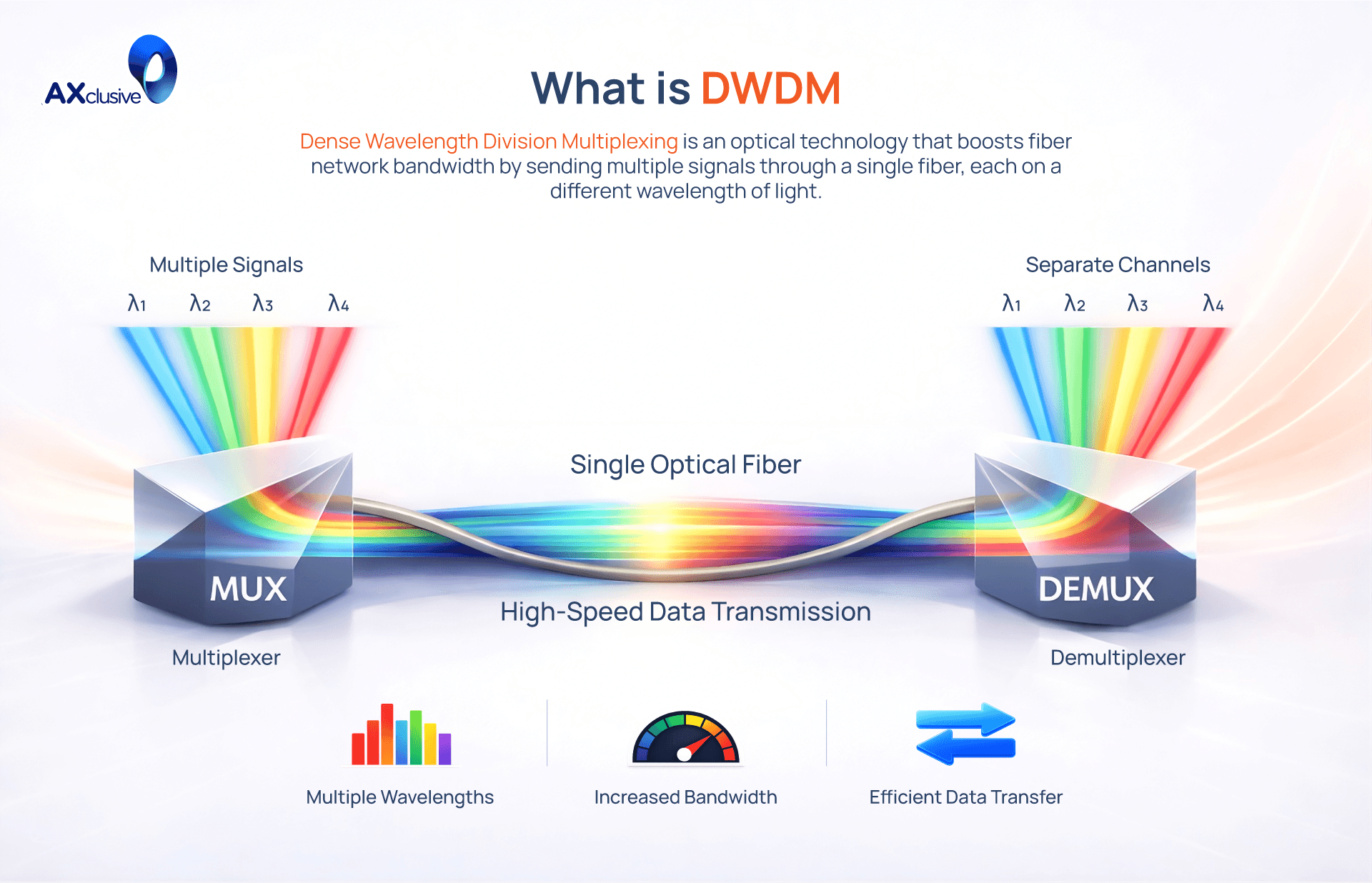
Dense Wavelength Division Multiplexing (DWDM) is an optical networking technology. It expands the bandwidth of a single fiber strand. The system works by assigning different data streams to specific light wavelengths. These wavelengths travel together through the glass core. The "dense" designation refers to the narrow gaps between each light channel. This precision allows for 80 or more channels on one fiber. DWDM enables large volumes of traffic to travel over long distances. It provides a scalable way to increase network capacity without laying new cables. Service providers use it to power the internet backbone and connect data centers.
How DWDM Technology Works in Optical Networks
DWDM technology operates by slicing a specific portion of the electromagnetic spectrum into extremely narrow segments. This precision allows multiple, distinct light signals to travel simultaneously through a single optical fiber pair without interfering with each other. It functions like a multi-lane highway where each lane is a different color of light, carrying its own unique stream of data.
To achieve this density, DWDM systems utilize the C-band (1525nm to 1565nm) or L-band (1570nm to 1610nm) light wavelengths. The critical factor is the channel spacing. A typical DWDM setup uses a microscopic 0.4nm (or 50 GHz) gap between wavelengths. This tight spacing enables the system to pack 88 or more individual channels onto one fiber strand. By multiplexing these signals at the source and demultiplexing them at the destination, network operators can exponentially multiply the capacity of their existing infrastructure without the massive expense of trenching new fiber-optic cables.
Key Components of a DWDM System
A Dense Wavelength Division Multiplexing network functions as a coordinated system of precision optical hardware. Each component plays a specific role in preparing, combining, and pushing light signals across vast distances without data corruption. Understanding these five primary elements is essential for designing and managing high capacity fiber infrastructure.
Signal transmission and reception units
The foundation of the network begins with the optical transmitters and receivers. Transmitters use highly precise lasers to convert incoming electrical data into distinct pulses of light. Each laser operates on a very specific wavelength to prevent interference. At the other end of the fiber, optical receivers capture these light pulses and convert them back into electrical signals that the destination hardware can process.
Wavelength combining and splitting systems
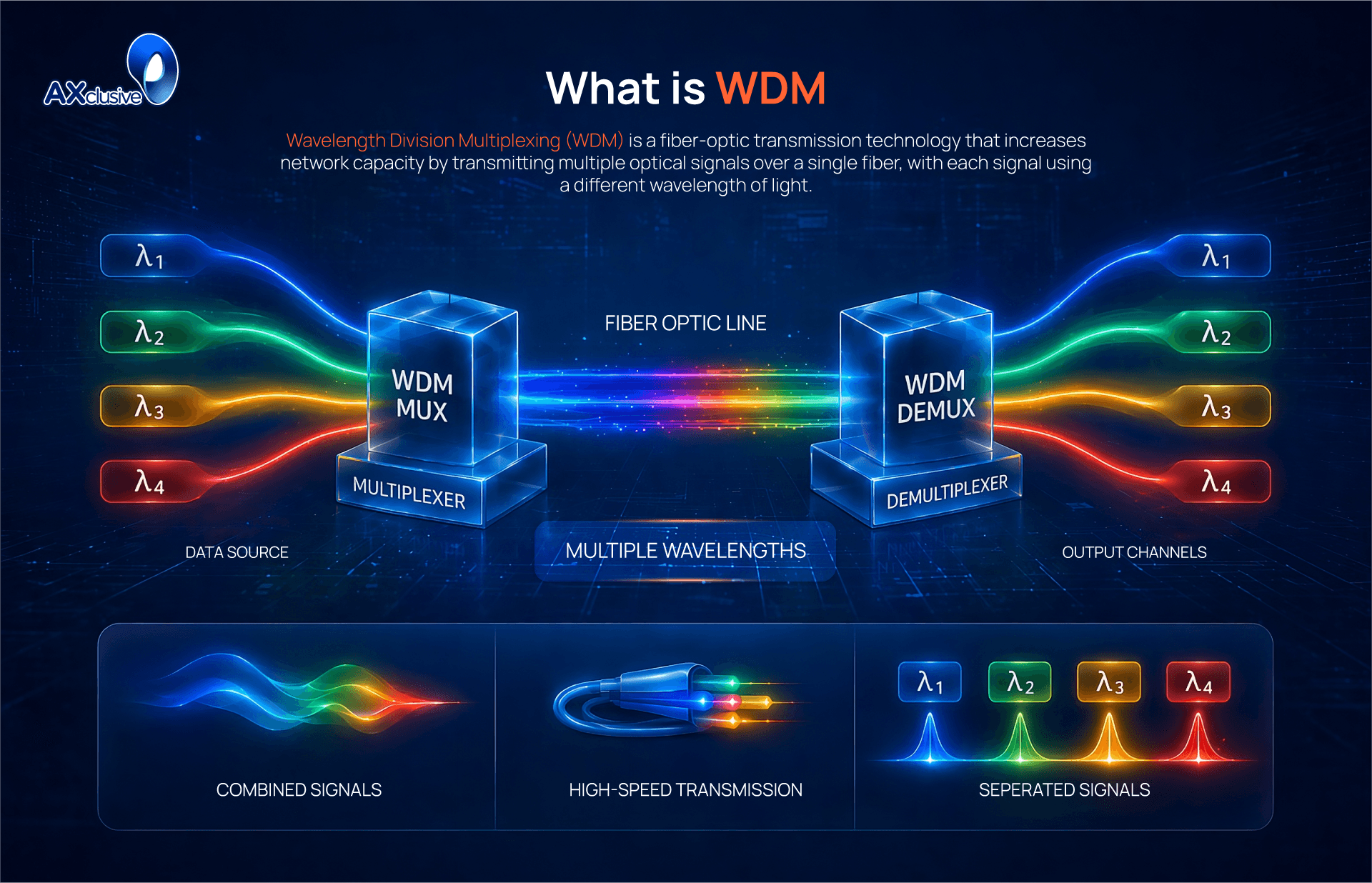
Once the individual light signals are generated, they must be combined onto a single fiber. This is the job of the Multiplexer (MUX). The MUX aggregates dozens of different wavelengths into one composite light beam. At the receiving terminal, the Demultiplexer (DEMUX) performs the exact opposite function. It separates the composite beam back into its original, individual wavelengths and routes each one to its designated receiver. These filters are typically passive devices, requiring no electrical power to operate.
Channel routing mechanisms
Networks are rarely simple point to point connections. Optical Add Drop Multiplexers (OADMs) are installed at intermediate locations along a fiber route. They act like highway off ramps, allowing specific wavelengths (channels) to exit the main fiber line and new signals to enter, while allowing the rest of the traffic to pass through uninterrupted. Modern networks use Reconfigurable OADMs (ROADMs), which allow engineers to route and reroute any wavelength dynamically via software without physically touching the hardware.
Signal amplification over distance
As light travels through fiber glass, it naturally loses strength (attenuation). Optical amplifiers are integrated directly into the fiber path to solve this. Instead of converting the light back to electricity, they stimulate the photons directly, boosting the signal amplitude. This optical amplification is what allows DWDM signals to travel thousands of miles, including across oceans, without degrading. Raman amplifiers are often deployed for extreme long haul transmissions.
Format and signal conversion devices
Optical transponders, often referred to as O E O (Optical Electrical Optical) converters, bridge the gap between standard network equipment and the DWDM system. A transponder takes a standard light signal from a client switch, converts it briefly into an electrical signal to clean it (reamplify, reshape, and retime), and then converts it back into a specific, colored DWDM wavelength. This ensures the signal is perfectly tuned before it enters the multiplexer.
Benefits of DWDM for High Capacity Networks
Dense Wavelength Division Multiplexing transforms a single optical fiber into a massive data pipeline. Network architects deploy this technology to solve immediate bandwidth shortages and prepare infrastructure for future growth. Utilizing this system provides distinct operational and financial advantages over installing new physical cables.
Massive Bandwidth Scalability: A standard DWDM system accommodates up to 96 separate wavelengths on one fiber pair. Each wavelength operates as a completely independent channel. You can transmit speeds from 10G up to 400G and beyond on every single channel. This massive scalability ensures your network handles sudden traffic spikes and future data demands without requiring new physical construction.
Maximized Cost Efficiency: Trenching the ground to lay new fiber optic cables requires expensive permits, labor, and time. DWDM allows you to maximize the capacity of the fiber infrastructure you already own or lease. By multiplying the throughput of existing glass strands, you drastically reduce capital expenditures and accelerate your network deployment schedule.
Complete Protocol Transparency: The technology transmits light, making it completely independent of the underlying data format. You can transport Ethernet, Fibre Channel, video feeds, and Optical Transport Network traffic simultaneously over the same fiber. Each service travels securely on its own dedicated wavelength. This transparency allows enterprises to converge multiple disparate networks into one unified optical backbone.
Ultra Long Distance Performance: Standard optical signals degrade over distance. DWDM overcomes this physical limitation by utilizing integrated optical amplifiers and Forward Error Correction. These features maintain strict signal integrity across hundreds or thousands of miles. You can seamlessly connect data centers across entire continents without needing to convert the light back into electrical signals at intermediate locations.
Vendor Neutral Flexibility: Modern DWDM architecture strongly supports open line systems. This flexibility frees your organization from strict vendor lock in. You can mix and match optical transceivers, multiplexers, and amplifiers from different hardware manufacturers. This open approach empowers network engineers to design custom, cost effective solutions tailored precisely to their specific operational requirements.
DWDM FAQs and Common Questions
Is a DWDM a switch?
No. DWDM is a multiplexing technology, not a network switch. A switch routes data packets at Layer 2 or Layer 3 of the network model. DWDM operates at the physical layer. It combines multiple light wavelengths onto a single physical fiber cable. You use a switch to direct network traffic, but you use DWDM to increase the raw capacity of the cables connecting those switches.
Which fiber is used in DWDM?
DWDM networks exclusively use single mode fiber. Single mode fiber has a very narrow glass core. This design prevents light signals from bouncing and overlapping over long distances. You cannot use multimode fiber for DWDM. Multimode causes severe signal dispersion, making it impossible to transmit tightly spaced wavelengths across miles of cable.
What is Ethernet over DWDM?
Ethernet over DWDM is a network architecture that transmits Ethernet frames directly over optical wavelengths. Historically, networks required a complex middle layer to package the data. Modern transceivers allow switches to send 10G, 100G, or 400G Ethernet traffic straight into the DWDM multiplexer. This direct connection reduces hardware costs, lowers network latency, and simplifies overall management.
What is the maximum bandwidth of DWDM?
The maximum bandwidth depends on the channel count and the speed per channel. A standard DWDM system supports 96 independent channels on a single fiber pair. Modern transceivers can push 400G or 800G of data across each individual channel. When you multiply 96 channels by 800G, a single fiber strand can achieve a total theoretical bandwidth exceeding 76 Terabits per second.
DWDM is the primary solution for maximizing your existing fiber utility. This technology allows you to scale bandwidth instantly while avoiding the high costs of new cabling. Axclusive provides the technical clarity needed to help you manage these complex optical systems effectively. Secure your network's future by applying these practical DWDM principles to build a more resilient infrastructure today.
What is DWDM and how it boosts high-capacity fiber networks. Contact us to build scalable, high-performance optical connectivity.