
Comparing PRI and SIP Trunking for Enterprise Communication
Choosing the right telephony standard is critical for business operations. You must evaluate PRI vs SIP trunking to determine your infrastructure needs. One relies on physical circuits while the other utilizes virtual IP connections. This choice affects your scalability and monthly budget. Join Axclusive to explore the technical differences and benefits in the article below
PRI vs SIP Trunking Key Differences
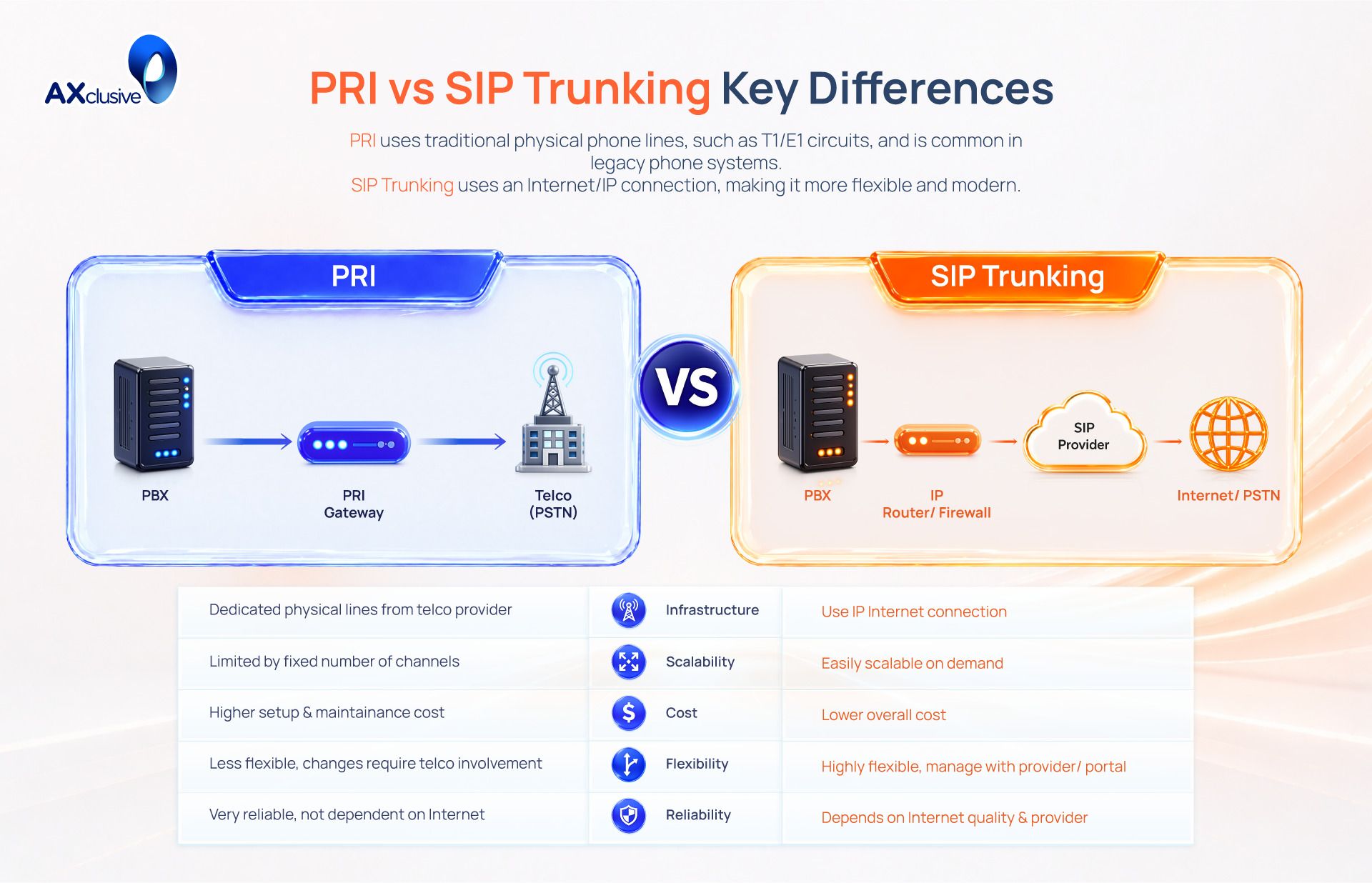
Understanding the technical distinction between PRI vs SIP trunking is essential for infrastructure planning. Primary Rate Interface (PRI) relies on physical copper circuits to deliver exactly 23 voice channels per line. In contrast, SIP trunking utilizes a virtual IP connection to provide unlimited, scalable communication lines over the internet. This fundamental difference between pri and sip trunking determines whether your network scales through manual hardware installation or instant software configuration.
| Feature | Primary Rate Interface (PRI) | SIP Trunking |
|---|---|---|
| Connection Medium | Physical copper wires (T1/E1 circuits) | Virtual connection via IP network |
| Capacity Unit | Fixed blocks of 23 channels (T1) | Granular (1 channel to unlimited) |
| Scaling Process | Requires physical installation and hardware | Instant software provisioning |
| Mobility | Tethered to a fixed physical address | Remote-friendly; works anywhere |
| Infrastructure | Requires on-premise PBX and T1 cards | Works with IP-PBX or Cloud systems |
| Redundancy | Manual failover; expensive to duplicate | Automatic rerouting and cloud backup |
| Voice Quality | Guaranteed on a dedicated circuit | Dependent on internet bandwidth and QoS |
| Maintenance | Requires on-site technical expertise | Managed remotely by the service provider |
| Financial Model | High CapEx for hardware and wiring | Low OpEx with monthly subscription |
| Modern Features | Mostly limited to voice services | Integrated video, chat, and data |
PRI vs SIP trunking advantages and limitations
Sip Trunking
| Operational Advantages | Technical Limitations |
|---|---|
| Direct Cost Reduction SIP eliminates the need for expensive physical T1/PRI line rentals. You pay only for the concurrent call capacity you actually use, turning high capital costs into predictable monthly operating expenses. | Internet Performance Reliance Voice quality depends entirely on your internet connection. Without sufficient bandwidth or stability, users may experience jitter, echoes, or dropped calls during peak traffic hours. |
| Elastic Scalability Organizations can add or remove channels instantly through a software portal, allowing communication systems to grow without waiting for physical installations. | Cybersecurity Exposure Internet-based voice services introduce risks like toll fraud and DDoS attacks. Strong firewalls and SRTP encryption are essential for security. |
| Infrastructure Consolidation SIP combines voice and data traffic over the same Ethernet or fiber network, reducing cabling complexity and hardware maintenance requirements. | Hardware Incompatibility Older analog PBX systems and legacy desk phones may not support SIP directly, often requiring costly upgrades or media gateways. |
| Native Disaster Recovery SIP enables automatic call rerouting to mobile devices or backup locations during outages, improving business continuity and uptime. | Single Point of Failure If the primary internet connection fails, the entire phone system may go offline unless a secondary redundant connection is in place. |
PRI
| Core Strengths (Advantages) | Critical Constraints (Limitations) |
|---|---|
| Dedicated Voice Performance Since PRI operates over a private circuit, call quality is guaranteed. It eliminates issues like jitter or latency caused by internet congestion. | High Capital Expenditure Setting up PRI requires a significant upfront investment in physical on-premise PBX hardware, T1 cards, and specialized wiring. |
| Legacy Compatibility PRI integrates seamlessly with older, non-IP telephone systems. Many businesses use it to maximize the lifespan of their existing hardware. | Rigid Scaling Model You cannot add a single line. PRI forces you to buy capacity in blocks of 23 channels, leading to high costs for unused resources. |
| High Security & Traceability Because the connection is a physical closed loop, it is difficult to intercept. Emergency services also find it easier to trace physical locations accurately. | Slow Recovery Times If a physical line suffers damage from construction or weather, repairs require an on-site technician visit, causing extended downtime. |
| PSTN Reliability The system does not depend on internet uptime. Your phone lines remain active as long as the building has power and the copper lines are intact. | Geographic Dependency PRI circuits are tied to a specific physical address. Moving your office requires a complex and costly relocation of the entire circuit. |
PRI vs SIP trunking migration considerations
Migrating from PRI vs SIP trunking is a strategic shift from rigid hardware to flexible software. This transition requires careful technical preparation to avoid communication gaps. You must align your local network with the requirements of internet-based voice delivery. A systematic approach ensures your business captures the cost benefits of SIP while maintaining the reliability your team expects. Follow these specific steps to move your infrastructure to the cloud successfully.
Evaluate current infrastructure
Start with a thorough audit of your existing hardware and bandwidth. Check your Private Branch Exchange (PBX) for IP compatibility. If your server only accepts physical T1 cables, you must install a media gateway to convert digital SIP signals into a format your hardware understands. Next, measure your internet performance. VoIP requires low latency and minimal jitter to function correctly. Ensure your router supports Quality of Service (QoS) protocols. You must prioritize voice packets over standard web traffic to prevent choppy audio during peak usage hours.
Select the right SIP provider
Choose a vendor based on reliability, scale, and technical support. Verify their network uptime guarantee. High-tier providers offer at least 99.99% availability. Compare metered pricing models for low-volume users against unmetered plans for heavy callers. Ensure the provider supports essential features like Direct Inward Dialing (DID) and emergency call routing. A reputable provider offers a clear number porting process. This ensures you keep your existing business identity without losing contact with clients during the move.
Execute deployment strategy
Implementation should follow a phased approach to minimize operational risk. Start by training your internal IT staff on the new SIP management dashboard. Request temporary phone numbers from your provider to test the new virtual lines before you disconnect your PRI circuits. This parallel run allows you to verify call quality and routing rules without risking live customer interactions. Once your testing confirms stable performance, initiate the official porting of your main business numbers to the new service.
Plan ongoing support and optimization
Establish a long-term maintenance plan after the initial setup completes. Secure a clear Service Level Agreement (SLA) that outlines specific response times for technical issues. Regularly review your call logs and bandwidth consumption to optimize your channel count. As your business expands, use the SIP portal to add new lines instantly. Ongoing employee training ensures your team utilizes advanced features like mobile integration and video conferencing effectively. Consistent monitoring prevents performance bottlenecks and maintains high-quality voice standards.
Modern telephony requires a clear choice between PRI and SIP trunking. Physical circuits provide localized stability. Virtual trunks offer rapid growth and lower costs. Axclusive delivers the technical details needed to guide your infrastructure migration. Use these practical insights to secure and scale your business communication for the future.
PRI vs SIP Trunking impacts business communication through scalability, flexibility, and infrastructure costs. Contact us to build reliable voice connectivity solutions with Axclusive ISP.