
What Is Internet Backbone and How It Works?
How does a video call from New York reach London in milliseconds? It travels through the internet backbone. This high-capacity network of fiber optics and core routers forms the primary data highway of the world. It is the invisible engine that powers global connectivity and the digital economy. Discover the architecture and mechanics of the internet backbone network with Axclusive in the guide below.
Internet Backbone Overview
The internet backbone is the central high-capacity infrastructure of the global web, consisting of interconnected fiber-optic networks and high-bandwidth routers. It is owned and operated by "Tier 1" Internet Service Providers (ISPs) who peer with each other to exchange traffic across continents without paying for transit. By utilizing the TCP/IP protocol suite, this core internet backbone network creates a single, unified path that allows smaller, local ISPs to deliver data to any destination worldwide. Essentially, it functions as the primary data highway that sustains the entire internet routing table.
Internet Backbone Core Components
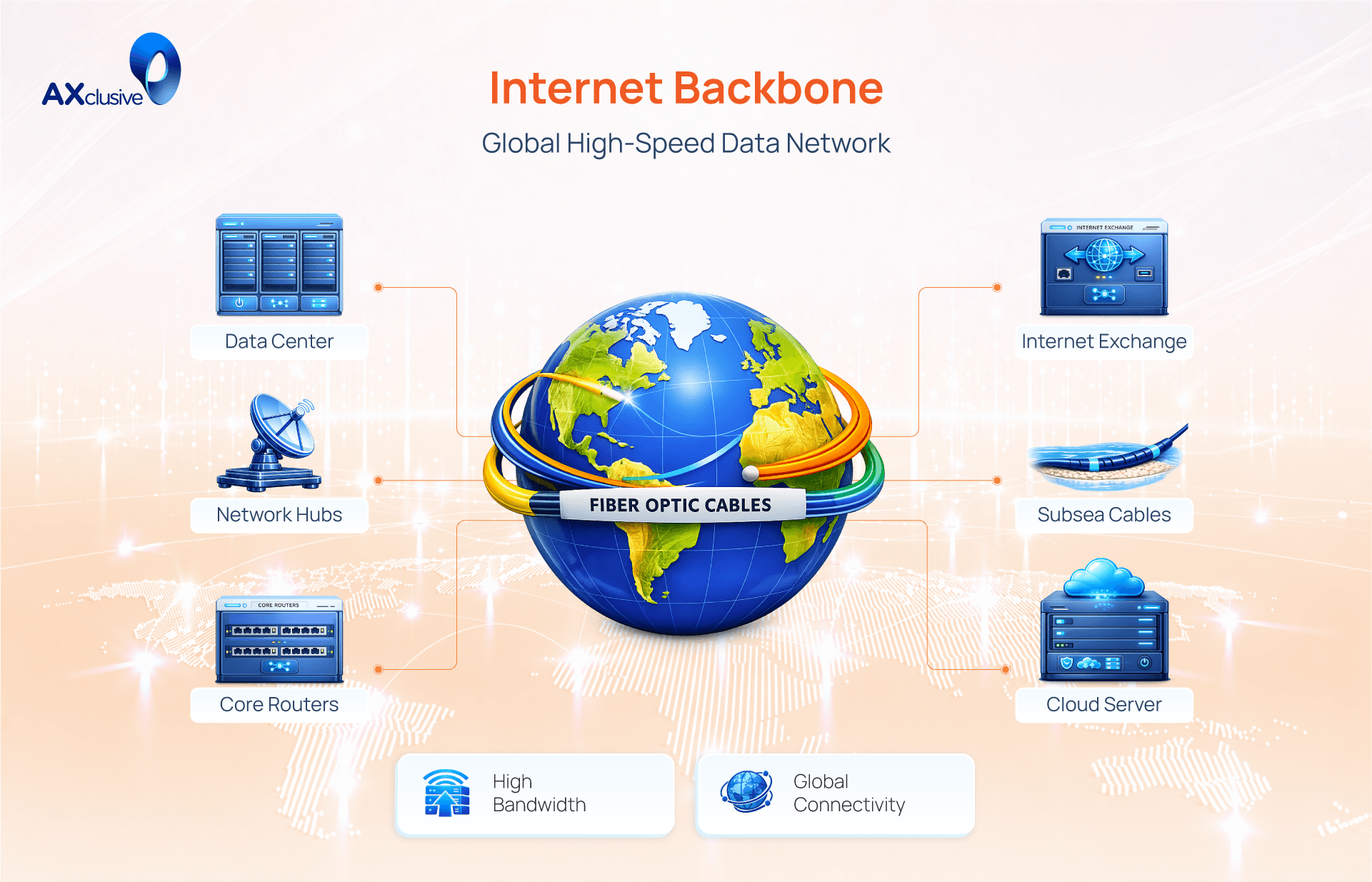
The internet backbone relies on specific hardware to maintain global connectivity. These physical systems ensure the isp backbone remains fast and resilient across continents. Understanding what is a internet backbone requires identifying these four essential parts:
Fiber-Optic Cables: These glass strands are the primary conduits of the internet backbone network. They use pulses of light to transmit data over thousands of miles with minimal signal loss.
High-Performance Routers: These machines act as traffic controllers for the isp backbone. They store routing tables and use protocols like BGP to direct data packets toward the most efficient paths.
Strategic Data Centers: These facilities are the anchors of the internet backbone network. They house the storage systems and servers that process and host the vast amount of data found on the web.
Submarine Cable Systems: These armored undersea lines connect different continents. They form the international segment of the internet backbone, allowing data to travel between nations at the speed of light.
How the Internet Backbone Operates
The internet backbone functions as the primary data highway. It moves vast amounts of information between continents in milliseconds. This process relies on a decentralized mesh of routers and fiber-optic lines. Each step in the process ensures your data reaches its destination efficiently.
Packetization and Data Entry: Your device breaks every message, email, or file into small data packets. These packets move from your local router to your regional isp backbone. From there, they enter the high-capacity backbone lines. This modular approach allows different parts of the same file to travel through separate paths if necessary.
Dynamic Path Selection (BGP): Backbone routers use the Border Gateway Protocol (BGP) to find the optimal route. This protocol acts as a traffic manager. It evaluates current network congestion, latency, and the number of hops. BGP ensures your data takes the most direct path to the destination, avoiding broken or overloaded links.
Physical Interconnection at IXPs: Providers link their networks at Internet Exchange Points (IXPs). These physical locations allow different internet backbone companies to swap data directly. This interconnectivity ensures that data flows seamlessly across the globe. It also prevents any single organization from controlling the entire internet backbone network.
Why the Internet Backbone Is Essential
The internet backbone provides the necessary infrastructure for several critical global functions. Its reliability determines the speed and stability of the digital services that society uses every day.
Enabling Global Communication: This network allows people to exchange information across continents instantly. Every email, video call, and message relies on the isp backbone to bridge the gap between local networks. It turns isolated regional systems into a unified global web.
Powering the Global Economy: Modern trade runs on the internet backbone network. It facilitates international banking, stock market trades, and e-commerce. Businesses use these links to manage supply chains and process transactions in real time. This system supports millions of jobs and sustains the digital marketplace.
Delivering High-Bandwidth Content: Users require high speeds for streaming, gaming, and cloud computing. The internet backbone provides the bandwidth needed to move large files at the speed of light. It ensures that content reaches the end-user without the delays common in smaller, local networks.
Supporting Research and Innovation: Scientific progress depends on the ability to share data. This infrastructure allows researchers to collaborate on a global scale. It provides the foundation for breakthroughs in technology, medicine, and engineering. Understanding what is a internet backbone helps illustrate why global progress depends on this high-capacity engine.
How Networks Access the Internet Backbone
Establishing a connection to the internet backbone is a technical process typically reserved for ISPs and large-scale enterprises. It requires specific physical infrastructure and logical routing configurations to ensure data flows correctly across the ISP backbone. The following steps outline how to secure backbone-level access:
- Select a High-Tier Provider: Choose an Internet Service Provider with direct links to the Tier 1 core. Tier 1 providers own the internet backbone, while Tier 2 providers rely on paid transit to reach it. Dedicated Internet Access (DIA) should be included to ensure guaranteed bandwidth.
- Deploy BGP-Capable Hardware: Use enterprise-grade routers that support the Border Gateway Protocol (BGP). Standard routers are not designed to manage global routing tables required for backbone communication. Hardware should include high-speed fiber-optic interfaces to support large data throughput.
- Establish a Physical Cross-Connect: Colocate equipment in a carrier-neutral data center or Internet Exchange Point (IXP). A physical fiber cross-connect links the router directly to the backbone provider’s infrastructure within the facility, helping to minimize latency.
- Obtain an Autonomous System Number (ASN): Register for an ASN and a block of public IP addresses through a Regional Internet Registry (such as ARIN or RIPE). This identifier allows the network to be recognized and properly routed across the global internet.
- Configure BGP Peering Sessions: Set up BGP sessions between the router and the backbone provider. This enables the network to advertise its IP prefixes and receive routing information for optimal path selection.
- Establish Peering Agreements: For larger networks, peering agreements at an IXP allow direct traffic exchange with other networks. This reduces reliance on paid transit and improves performance by keeping traffic local.
- Monitor Performance Metrics: Use network monitoring tools to track latency, packet loss, and BGP stability. Regular audits of routing hardware help ensure compatibility with the continuously growing global routing table.
Internet Backbone Limitations and Challenges
| Feature | Key Advantages (The Power of the Backbone) | Limitations & Challenges (The Risks Involved) |
|---|---|---|
| Performance | Extreme Throughput: Moves terabits of data per second using light-based fiber optics. | Latency Constraints: Physical distance and hops affect speed. |
| Resilience | Built-in Redundancy: Self-healing mesh reroutes traffic instantly. | Physical Vulnerability: Submarine cables can be damaged. |
| Connectivity | Global Reach: Connects ISP networks worldwide. | Geopolitical Barriers: Affected by regulations. |
| Economics | Efficient Scalability: Upgrade lasers without new fiber. | High Costs: Requires large capital investment. |
| Security | Standardized Protocols: Uses TCP/IP and BGP. | Security Risks: Vulnerable to hijacking attacks. |
| Management | Peering Efficiency: Reduces transit costs. | High Complexity: Requires expert-level management. |
Understanding the internet backbone empowers you to build more resilient network architectures. This infrastructure enables high-speed data transit across continents while maintaining the stability of the global digital economy. Apply the practical insights shared by Axclusive to optimize your connectivity and navigate the complexities of global networking with confidence
Contact us today to strengthen your internet backbone and power reliable, high-performance enterprise connectivity.