
What Is Redundant Routing? Benefits, Use Cases and Implementation
Modern networks must remain available even when links or devices fail. Redundant routing provides multiple paths and automatic failover to maintain continuous connectivity. Explore more with Axclusive ISP in this article.
What is Redundant Routing?
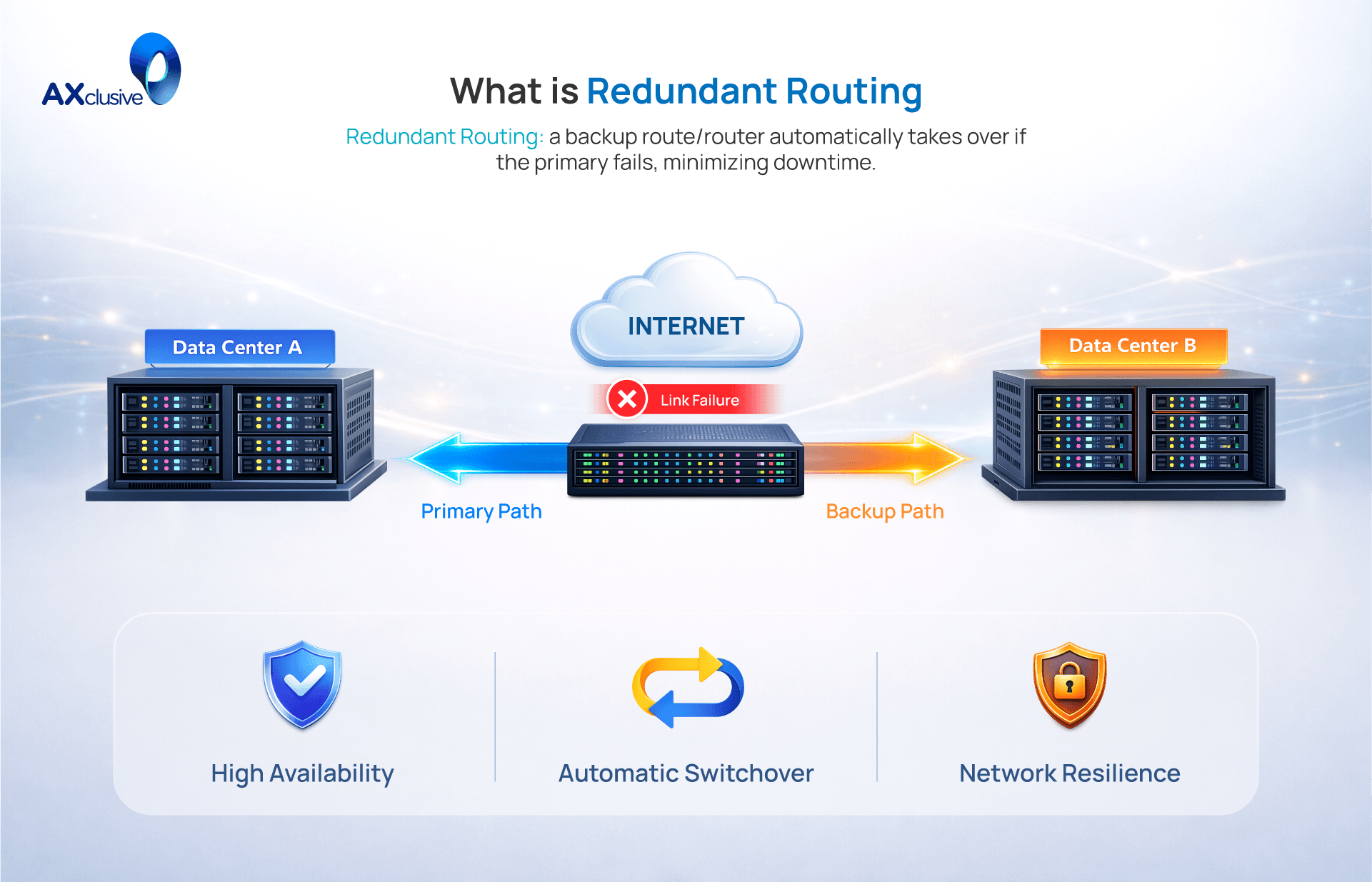
Redundant routing refers to a network design approach where multiple links and routing paths exist between communication endpoints to ensure continuity of service. When a primary route becomes unavailable due to failure or degradation, traffic is automatically redirected through alternate paths, allowing connections to remain active without manual intervention. This mechanism is often described as failover routing because it prioritizes uninterrupted connectivity.
In voice and communication systems, redundant routing plays a critical role in maintaining service availability. By combining backup routing paths with redundant hardware, power sources, and routing intelligence, organizations reduce the risk of call drops and service outages. Effective implementation starts with identifying critical and high-risk network segments, then deploying secondary equipment, alternative network paths, and reliable backup power such as UPS or generators. When designed correctly, redundant routing strengthens network reliability, supports business continuity, and ensures consistent performance even during unexpected failures.
Ensure smoother communication and better network performance with dedicated internet access tailored for modern business needs.
Key Benefits of Redundant Routing in Network Design
Redundant routing strengthens network design by ensuring traffic can continue flowing even when individual components fail. Instead of relying on a single path, networks are built with alternative routes, backup links, and failover logic that protect availability and performance. This approach is essential for modern environments that depend on continuous connectivity, such as enterprise systems, healthcare platforms, financial services, and cloud-based applications.
Below are the key benefits of implementing redundant routing in a structured network design.
Want to improve network performance and distribute traffic more efficiently? Explore our guide on What Is Load Balancing to learn how load balancing helps maintain stability, optimize resources, and enhance user experience.
Stronger Network
Redundant routing creates a more resilient network by removing dependence on a single path or device. When multiple routes exist between endpoints, the network can maintain connectivity even during hardware faults, link degradation, or maintenance events. This structural strength improves overall stability and reduces the likelihood of widespread outages.
Better Fault Tolerance
Fault tolerance improves when routing protocols can detect failures and redirect traffic automatically. Redundant routing allows the network to absorb component failures without interrupting services. This capability ensures that localized issues do not escalate into full service disruptions.
Reduced Service Interruptions
By maintaining alternate paths, redundant routing minimizes the impact of link or device failures. Traffic shifts away from the affected route in real time, allowing applications and users to continue operating without noticeable interruption. This is critical for services that require consistent uptime.
Automated Failover Mechanisms
Redundant routing supports automated failover through routing protocols and monitoring systems. When a primary route becomes unavailable, traffic is redirected to a backup path without manual intervention. This automation reduces recovery time and removes reliance on human response during incidents.
Built-In Traffic Distribution
Multiple available routes enable traffic to be distributed across paths instead of concentrating load on a single link. This reduces congestion and prevents bottlenecks, especially during peak usage. Balanced traffic distribution also helps maintain consistent performance across the network.
Higher Overall Network Availability
Redundant routing increases availability by ensuring that connectivity remains intact even during failures. Networks designed with redundancy can meet high availability targets and service-level agreements, which is essential for organizations that operate around the clock.
Smarter Use of Network Resources
Instead of leaving backup links idle, redundant routing allows networks to actively use available paths. Traffic can be shared or dynamically adjusted based on conditions, improving utilization and avoiding wasted capacity while still preserving protection against failures.
Improved Traffic Flow Control
With multiple routing options, networks gain greater control over how data moves. Policies can guide traffic based on performance, priority, or application type. This improves predictability and helps ensure that time-sensitive services receive appropriate treatment.
Lower Risk from Network Failures
Redundant routing reduces operational and financial risk by limiting the impact of unexpected failures. Even when disruptions occur, services remain accessible, protecting revenue, productivity, and user trust. This proactive approach shifts networks from reactive recovery to continuous operation.
Why Redundant Routing Makes Sense for Modern Networks
Modern networks support critical business operations where availability, performance, and reliability are non-negotiable. Redundant routing addresses these requirements by ensuring traffic can continue flowing even when links, devices, or entire segments fail. Rather than reacting to outages, organizations design networks that absorb failures and maintain service continuity by default.
The following points explain why redundant routing has become a practical requirement for today’s networks.
Resilient Network Operations
Redundant routing strengthens day-to-day operations by removing reliance on single paths. When multiple routes exist, the network continues functioning even during hardware faults or link degradation. This resilience supports consistent access to applications and services without operational disruption.
Downtime Prevention
Automatic path switching prevents minor failures from escalating into outages. Traffic reroutes instantly when a primary path becomes unavailable, keeping services online. This proactive behavior reduces service interruptions and maintains productivity across the organization.
Improved Disaster Recovery
Redundant routing plays a key role in disaster recovery strategies. By maintaining alternative routes across locations or providers, networks remain accessible during power failures, infrastructure damage, or regional disruptions. Critical systems stay reachable when recovery speed matters most.
Stable Traffic Flow
Traffic stability improves when data can traverse multiple paths instead of competing for a single route. Redundant routing reduces congestion and smooths performance during peak usage, ensuring predictable delivery even under heavy load.
Seamless Failure Handling
Failures are handled in the background without user impact. Routing protocols detect issues and redirect traffic without manual intervention, allowing work to continue uninterrupted. This transparency improves user confidence in network reliability.
Efficient Traffic Control
Redundant routing supports intelligent traffic management by distributing load across available routes. Combined with routing policies and load-aware decisions, networks avoid overload conditions and maintain consistent response times.
SLA Compliance
Service level agreements often require strict uptime guarantees. Redundant routing helps meet these commitments by keeping systems operational during maintenance events or unexpected failures. High availability becomes a design feature rather than a reactive goal.
Scalability Readiness
As networks grow, redundant routing scales without major redesign. New links and locations integrate smoothly, while existing redundancy mechanisms continue to protect performance and availability. This flexibility supports long-term expansion.
Reduced IT Overhead
Automated failover reduces emergency response and manual troubleshooting. IT teams spend less time responding to outages and more time improving infrastructure, security, and performance planning.
Lower Downtime Costs
Service outages lead to lost revenue, reduced productivity, and damaged trust. Redundant routing minimizes these risks by keeping systems accessible during failures. Over time, the cost savings outweigh the investment in redundancy.
Where Does Redundant Routing Make the Most Difference?
Redundant routing delivers the highest value in environments where network availability directly impacts operations, safety, or revenue. In these contexts, connectivity failures are not just technical issues but business and operational risks. By providing alternate traffic paths and automated recovery, redundant routing supports continuity in systems that cannot afford disruption.
Data Center Environments
Data centers host critical workloads such as cloud services, enterprise applications, and data processing platforms. Network interruptions at this layer can affect multiple services simultaneously. Redundant routing ensures that traffic continues flowing when links or routing devices fail, preserving application availability and supporting maintenance without service disruption.
Corporate Networks
Enterprises rely on consistent connectivity for collaboration tools, cloud applications, and internal systems. Redundant routing protects business operations by maintaining access to these services during link failures or routing issues. This design reduces dependency on single paths and supports predictable network behavior across distributed offices.
Internet Service Provider Networks
ISPs operate large-scale networks with strict performance and uptime expectations. Redundant routing allows providers to manage congestion, equipment failures, and traffic surges without impacting end users. This capability is essential for maintaining service quality and meeting contractual service level commitments.
Government and Public Infrastructure
Public sector networks support essential services such as healthcare systems, transportation networks, and emergency communications. In these environments, connectivity failures can have serious consequences. Redundant routing helps ensure continuous operation during outages or infrastructure disruptions, supporting reliability and public safety.
Online Commerce Platforms
E-commerce platforms depend on uninterrupted connectivity to process transactions and serve customers. Even short outages can result in lost revenue and reduced customer trust. Redundant routing minimizes downtime by keeping online services accessible when primary network paths fail.
Remote and Hybrid Work Environments
Distributed work models rely on stable access to cloud platforms, collaboration tools, and shared resources. Redundant routing supports reliable connectivity for remote users by reducing the impact of network failures and improving overall access consistency across locations.
Practical Tips for Implementing Redundant Routing
Implementing redundant routing requires more than adding backup links. A reliable design depends on understanding risk, selecting the right routing logic, validating failover behavior, and maintaining visibility over time. When executed correctly, redundant routing strengthens stability without adding unnecessary complexity.
Network Risk Assessment
A successful redundancy strategy begins with a clear assessment of network risk. Organizations should identify where failures are most likely to occur and which segments would cause the greatest operational impact if disrupted. This includes evaluating core links, edge connections, provider dependencies, and high-traffic paths. By understanding these weak points, redundancy can be applied where it delivers the highest value rather than increasing cost without improving resilience.
Routing Protocol Selection
Routing protocols determine how quickly and accurately traffic adapts to failures. The choice should reflect network size, complexity, and operational requirements. Internal routing protocols must converge fast and remain stable, while external routing must support policy control and provider diversity. Selecting protocols that align with the network’s structure ensures predictable failover behavior and avoids routing instability during disruptions.
Failover Optimization
Failover does not occur automatically unless routing priorities and detection mechanisms are carefully configured. Primary and secondary paths must be clearly defined so traffic shifts immediately when a failure is detected. Fast detection tools and optimized routing metrics help reduce transition time, preventing noticeable service interruption. Proper failover tuning ensures redundancy functions as intended under real conditions.
Failover Testing
Redundant routing must be validated through regular testing. Simulating link failures, device outages, or configuration errors confirms that backup paths activate correctly and traffic remains stable. Testing also reveals hidden dependencies or timing issues that may not appear during normal operation. Consistent testing builds confidence that the network will respond reliably during actual incidents.
Load Balancing Integration
Redundancy is most effective when combined with intelligent traffic distribution. Load balancing allows multiple paths to remain active, reducing congestion and preventing overreliance on a single route. This approach improves performance during normal operation while ensuring smooth transitions if one path becomes unavailable.
Network Monitoring
Continuous monitoring is essential for maintaining redundant routing. Visibility into route health, latency, packet loss, and failover events allows teams to detect degradation before it becomes an outage. Monitoring also ensures backup paths remain functional and not silently degraded over time. Without visibility, redundancy becomes an assumption rather than a verified capability.
Scalable Design
Redundant routing should support future growth without redesign. A scalable architecture allows new sites, links, or providers to be added using consistent patterns. This reduces operational overhead and ensures redundancy remains effective as traffic volumes and business demands increase.
Network Segmentation
Segmentation improves resilience by limiting the scope of failures. By separating routing domains or traffic classes, issues in one area do not propagate across the entire network. This approach simplifies troubleshooting and supports both performance and security objectives.
Diverse Physical Paths
Logical redundancy alone is insufficient if all routes depend on the same physical infrastructure. True resilience requires diversity at the physical layer, including separate carriers, paths, or connection types. Physical diversity protects against outages caused by construction damage, power failures, or regional disruptions.
Team Training
Redundant routing is only effective when teams understand how it works. Clear documentation, defined response procedures, and regular knowledge sharing ensure staff can manage failover events confidently. Trained teams reduce recovery time and prevent missteps during critical situations.
Expert Support
For complex or large-scale networks, expert guidance can prevent costly design errors. Experienced specialists help validate architecture, optimize routing behavior, and align redundancy with business priorities. This support often shortens deployment time and improves long-term reliability.
Designing for Redundancy Across OSI Layers
Network redundancy is most effective when it is designed systematically across multiple layers of the OSI model. Rather than relying solely on backup hardware, a layered approach ensures that connectivity can be maintained even when failures occur at different points in the network. Each OSI layer contributes specific mechanisms that help minimize disruption and maintain consistent data flow.
Layer 1 & Layer 2
At the physical and data link layers, redundancy focuses on protecting links and maintaining stable local connectivity. Multiple physical connections can be deployed between network devices to prevent single-link failures from disrupting traffic.
Link aggregation techniques allow several physical interfaces to operate as a single logical link. If one connection fails, traffic continues over the remaining links without interruption. At the same time, data link layer control mechanisms help prevent network loops and ensure that redundant paths do not introduce instability.
Layer 3
At the network layer, redundancy ensures that routing and gateway services remain available when devices or paths fail. This layer manages how traffic moves between networks, making it critical for maintaining end-to-end connectivity.
Gateway redundancy mechanisms allow a standby router to take over seamlessly if the primary device becomes unavailable. In larger or more dynamic environments, routing protocols automatically adapt to topology changes by recalculating paths and redirecting traffic away from failed components.
Frequently Asked Questions (FAQ)
What is the purpose of redundant routers?
Redundant routers are used to maintain continuous network connectivity when a primary router fails. By deploying backup routers, traffic can be automatically redirected without service interruption. This improves network availability, supports high uptime requirements, and reduces the risk of downtime caused by hardware faults, maintenance, or unexpected outages.
What is an example of a redundant system?
A common example of a redundant system is a network with two routers configured in an active-standby setup. If the active router stops responding, the standby router takes over traffic handling automatically. Other examples include dual power supplies in servers, multiple internet connections from different providers, or replicated data centers operating in parallel.
How does redundancy work?
Redundancy works by duplicating critical components or paths within a system so that failures do not stop operations. In networking, this often involves multiple routers, links, or power sources combined with monitoring and failover mechanisms. When a failure is detected, traffic or workload is shifted to an available backup component, ensuring uninterrupted service.
What is the difference between DMR and TMR?
DMR (Dual Modular Redundancy) uses two identical components to provide backup in case one fails. It improves availability but cannot independently verify which component is correct if results differ. TMR (Triple Modular Redundancy) uses three components and relies on majority voting to determine correct output. TMR offers higher fault tolerance and error detection but requires more resources and higher cost.
In summary, redundant routing provides a practical foundation for building reliable and resilient networks. By ensuring alternative paths, automated failover, and stable traffic flow, it helps organizations reduce downtime and protect critical services. Through the overview in this article, Axclusive has highlighted how redundant routing supports modern network design and long-term operational continuity.