
What Is SIP Trunking in VoIP Networks
Are you still paying for expensive, traditional phone lines? It is time to upgrade your business communication network. What is SIP Trunking? It is a digital technology that allows you to make and receive phone calls over the internet. It replaces physical copper wires with flexible, virtual connections. This technology lowers your operational costs and scales easily as your team grows. Join Axclusive ISP in the article below to explore how this system works and why your business needs it today.
What is SIP Trunking?
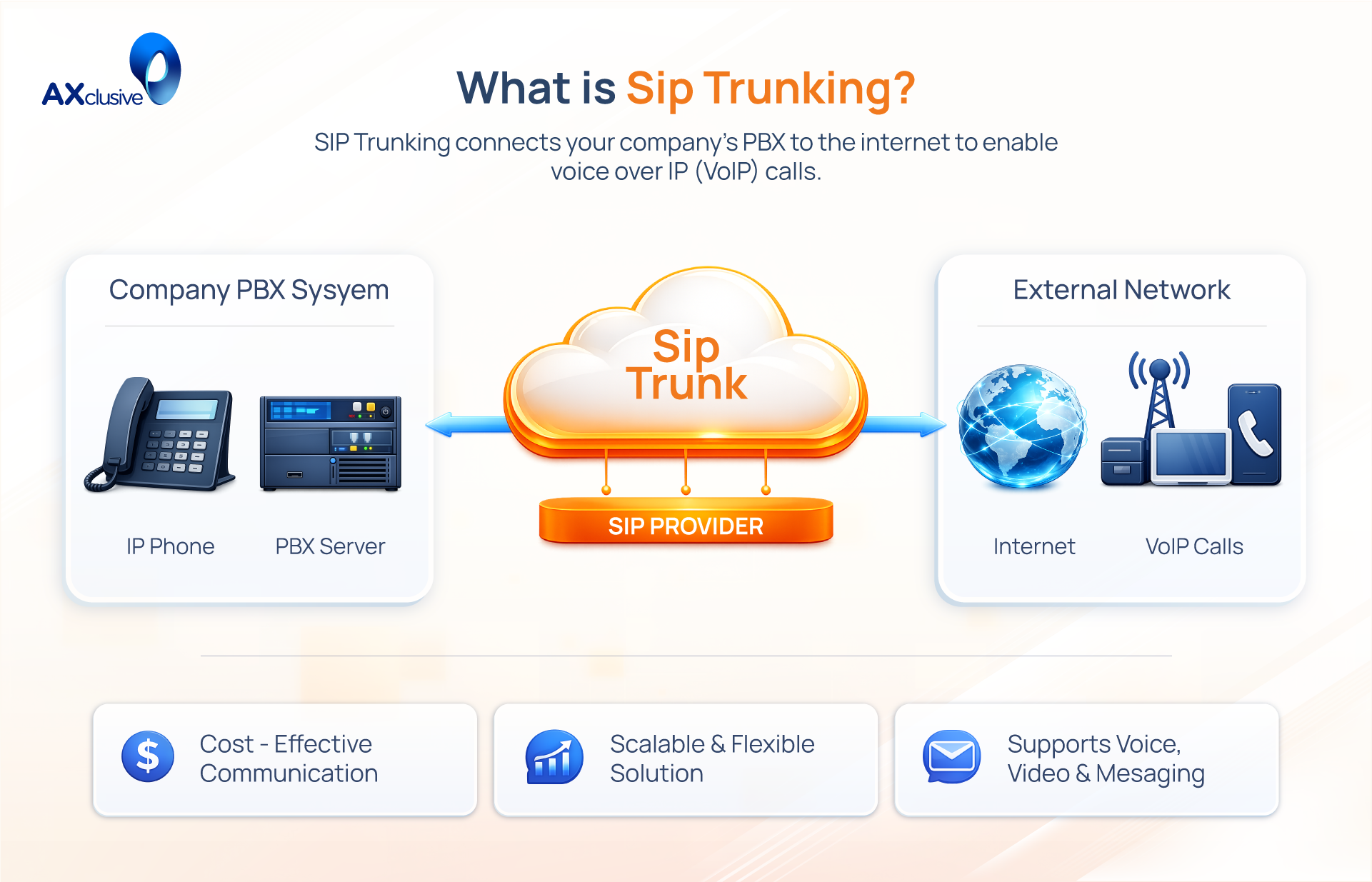
SIP trunking (Session Initiation Protocol trunking) is a digital technology that allows businesses to make and receive phone calls over an internet connection. In traditional telecommunications, a trunk is a bundle of physical copper wires. In SIP trunking, this trunk becomes a virtual connection. It links your company’s private phone system (PBX) directly to the traditional public phone network using internet protocols.
This technology transfers more than just voice data. SIP trunks manage multimedia communications, including video conferencing and instant messaging, through a single connection. Telecommunication providers worldwide are actively shutting down legacy analog and ISDN networks. Consequently, SIP trunking now serves as the modern, permanent replacement for these outdated physical phone lines.
Benefits of SIP Trunking
Lower Communication Expenses
SIP trunking helps businesses reduce telephony costs by replacing traditional phone lines with internet-based connections. Instead of paying for multiple physical lines and maintenance, companies typically pay per channel or based on concurrent calls. This model eliminates unused lines and lowers international calling costs. Many providers also offer flexible pricing options, allowing businesses to pay only for the capacity they actually use.
Easy Capacity Expansion
SIP trunking allows organizations to scale their communication capacity quickly. New channels can be added without installing additional hardware or infrastructure. As call volumes grow, businesses can increase bandwidth or channels to support more concurrent calls. This flexibility makes it easier to support multiple offices, remote teams, or expanding operations.
Access to Real Time Call Insights
Most SIP trunking platforms provide access to real-time call analytics and reporting tools. Businesses can monitor call volume, usage patterns, and service availability through centralized dashboards. These insights help organizations understand communication trends, evaluate team performance, and identify areas for improvement in customer service or sales operations.
Centralized Communication Control
SIP trunking enables companies to manage voice communication from a single platform. Calls, messaging, and conferencing services can be integrated into one unified system. Centralized management simplifies administration, reduces operational complexity, and allows IT teams to configure or monitor communication services across multiple locations.
Consistent Voice Performance
When supported by sufficient bandwidth and proper network configuration, SIP trunking delivers clear and stable voice calls. Voice traffic can be prioritized using Quality of Service (QoS) policies to maintain call quality during busy periods. Modern VoIP technologies also help reduce issues such as echo, latency, or packet loss, ensuring reliable communication.
Stronger Communication Security
SIP trunking services typically include security features designed to protect voice traffic. Providers often monitor call activity for unusual patterns and support encryption or authentication mechanisms to prevent unauthorized access. These protections help reduce risks such as fraud, call interception, or service misuse.
Flexible Deployment Options
Because SIP trunking is not tied to physical phone lines or local exchanges, businesses can operate more flexibly. Organizations can use local phone numbers in different regions while managing calls from a centralized system. If a company relocates or expands to new offices, existing numbers and communication systems can usually move without major infrastructure changes.
How SIP Trunking Operates in IP Communication Networks
SIP trunking converts analog voice signals into digital data packets for internet transmission. The system uses the Session Initiation Protocol (SIP) to establish, manage, and terminate voice and video sessions. It replaces physical copper wires with virtual, software-based trunks. These virtual trunks group multiple communication channels together, allowing you to scale your network capacity instantly without installing new hardware. Ultimately, the SIP trunk acts as a digital bridge between your internal Private Branch Exchange (PBX) and external public telephone networks. This connection enables your business to route all inbound and outbound calls securely over your existing internet connection.
Potential Limitations of SIP Trunking
SIP trunking provides significant business advantages, but it introduces new operational risks. Moving your voice network to the internet means your phone system inherits the vulnerabilities of your local data network. You must understand these potential limitations to build a resilient communication infrastructure.
Dependence on Reliable Internet Access
SIP trunking relies entirely on your internet connection. If your Internet Service Provider (ISP) experiences an outage, your phone system fails immediately. This creates a critical single point of failure for businesses that depend on continuous voice communication.
To mitigate this risk, you must implement network redundancy. Install a secondary internet connection from a different provider. Configure your network router to perform an automatic failover to a backup 4G or 5G cellular network. This guarantees your phone lines remain active during a primary ISP failure.
Voice Quality Issues Without Traffic Prioritization
Voice data travels across the exact same network as your standard web traffic. If you do not manage this data flow, network congestion will degrade your call quality. You will experience latency, jitter, and dropped audio packets during peak office hours.
You solve this by configuring Quality of Service (QoS) rules on your hardware. QoS prioritization guarantees that voice packets always jump to the front of the network queue. For larger enterprise environments, you should use a dedicated internet circuit exclusively for SIP traffic. This eliminates bandwidth competition entirely.
Security Risks in VoIP Environments
SIP converts private voice calls into standard data packets. This digital format makes your communications vulnerable to interception, toll fraud, and denial-of-service attacks if you leave the network unprotected. Cybercriminals frequently target unsecured VoIP systems to steal data or route fraudulent international calls.
You must secure your SIP trunks using strict cybersecurity practices. Ask your provider to enable Transport Layer Security (TLS) and Secure Real-time Transport Protocol (SRTP) to encrypt all call data. Configure a robust firewall to block unauthorized access attempts and enforce strict endpoint authentication.
Service Disruptions During Power Failures
Traditional analog phones draw electrical power directly from the copper telephone line. They remain functional during a local building power outage. SIP phone systems, network switches, and routers require standard wall power to operate. A localized power cut instantly disables your entire digital communication network.
You protect your phone system by installing Uninterruptible Power Supply (UPS) units. Connect your modems, routers, and Power over Ethernet (PoE) switches directly to these battery backups. For extended outages, you must deploy an onsite generator or configure your SIP provider settings to route incoming calls automatically to employee mobile phones.
SIP Trunking FAQ
What is the difference between SIP and SIP trunking?
SIP (Session Initiation Protocol) is a signaling protocol used to start, manage, and end communication sessions such as voice or video calls over IP networks. SIP trunking is a service that uses the SIP protocol to connect a business phone system (PBX) to the public telephone network through the internet, replacing traditional phone lines.
Does SIP trunking work with any phone system?
SIP trunking works with most IP-based PBX systems or VoIP-enabled phone platforms. Traditional phone systems can also use SIP trunking if they support SIP or if a compatible gateway is installed to connect the system to an IP network.
What key features should you evaluate when selecting a SIP trunking service?
When choosing a SIP trunking provider, businesses should consider factors such as call quality, network reliability, security features, scalability, geographic coverage, and support for emergency services. It is also important to review service level agreements (SLA) and monitoring capabilities to ensure consistent performance.
Through the information above, you now have a deeper understanding of SIP trunking and its critical role in modern communications. Axclusive hopes this guide empowers your business to confidently upgrade its infrastructure, reduce costs, and scale your global voice network efficiently.
🌍 Contact us today to learn what is SIP trunking and how it can improve your VoIP performance, scalability, and business communication. 🚀
Back to blog