
What Is Last Mile Connectivity in Internet Networks
Have you ever wondered why your internet connection is only as good as its final segment? Understanding what is last mile connectivity is crucial for optimizing both home and business network performance. This terminal link acts as the essential bridge between a provider’s core infrastructure and your physical premises. Join Axclusive in the article below as we explore how it works and why it remains the most vital part of your communication infrastructure.
What is last mile connectivity?
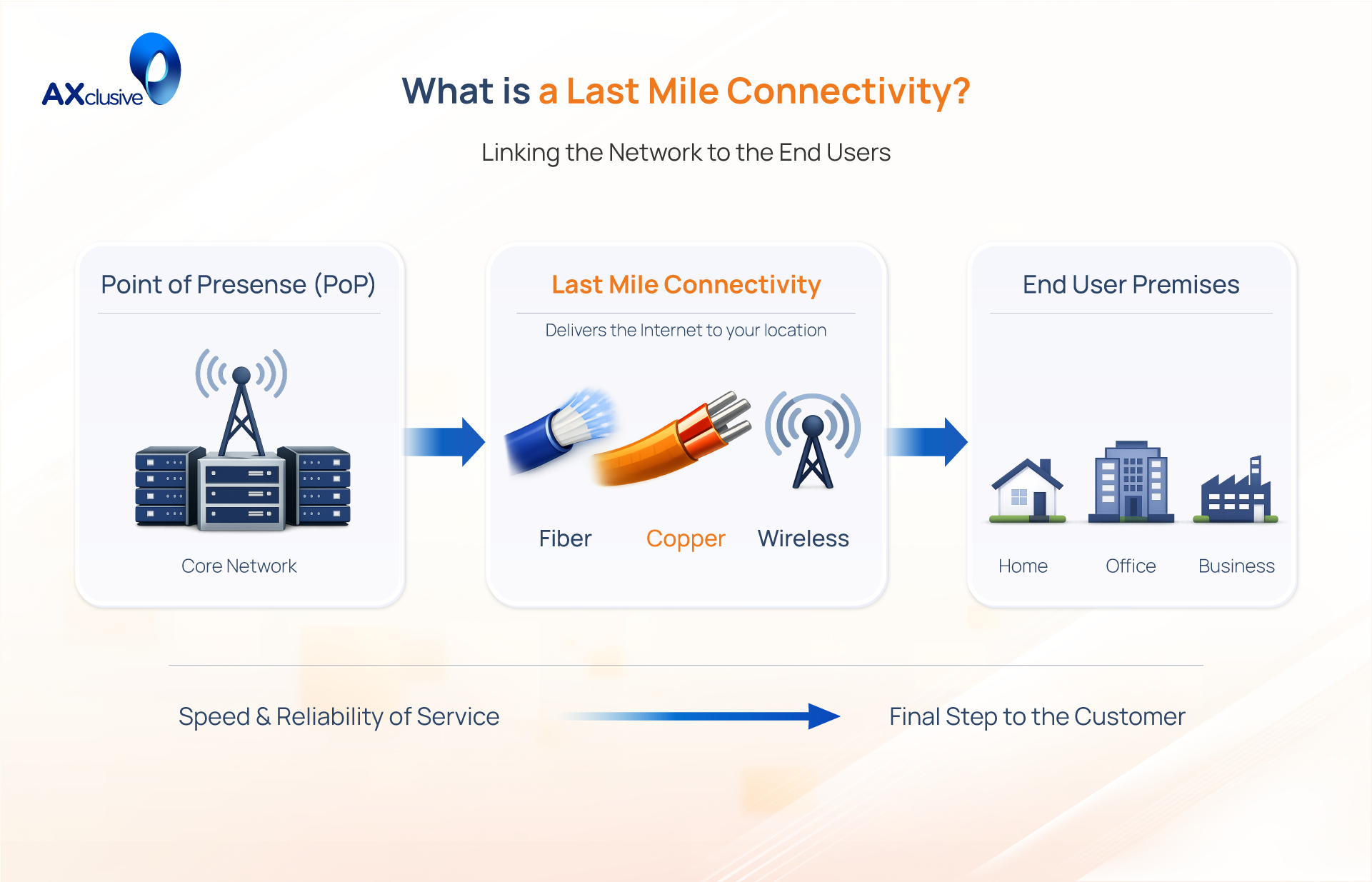
Last mile connectivity is the final segment of the telecommunications network that physically connects a service provider’s core infrastructure, or Point of Presence (PoP), to an end-user’s physical premises. This crucial link, which can be delivered via fiber, copper, or wireless technology, directly determines the ultimate speed and reliability of an internet service, as it represents the terminal point of data delivery before it reaches the customer.
How Last Mile Connectivity Works
Data’s journey from the internet to your office occurs in three stages: the high-capacity internet backbone connecting continents, the middle mile connecting regions, and the last mile. The last mile is the final, critical segment of this journey, delivering data from your service provider’s local infrastructure directly to your business premises. The technology used in this final link determines the performance and reliability of your entire connection.
The primary operational difference in last-mile connectivity lies in how bandwidth is allocated. There are two distinct models: contended and dedicated connections.
Shared Bandwidth Access
This is the model used by standard business broadband services like Fiber-to-the-Premises (FTTP) or Fiber-to-the-Cabinet (FTTC). In a contended network, the bandwidth on the last-mile link is shared among multiple users in the area. This means that during peak business hours, when many users are active, your internet speed can fluctuate and slow down as you compete for available capacity. While cost-effective, this model cannot guarantee performance.
Dedicated Line Access
For businesses requiring consistent performance, a dedicated connection is the standard. Services like Dedicated Internet Access (DIA), also known as a leased line, provide a private, uncontended last-mile link directly to your network. Key characteristics include:
- Guaranteed Bandwidth: You do not share your connection. Your upload and download speeds are symmetrical and guaranteed, typically up to 10Gbps or higher.
- High Reliability: Dedicated connections are backed by a Service Level Agreement (SLA). This contract guarantees specific levels of uptime (often 99.9% or higher) and defines fault resolution times.
- Enhanced Resilience: These services often include options for resilience, such as providing dual, diversely routed fiber paths to your premises to protect against physical cable cuts.
Types of Last Mile Technologies Used Today
The technology used to deliver the last mile of connectivity directly impacts its speed, reliability, and cost. Each method offers distinct advantages and is suited for different geographic and business environments. From high-speed fiber for dense urban centers to satellite for remote locations, the choice of last-mile technology is a critical infrastructure decision.
Fiber Optic Access Networks
Fiber optic technology represents the gold standard for last-mile connectivity. It uses thin strands of glass to transmit data as pulses of light, offering unparalleled speed and reliability.
- Performance: Delivers symmetrical upload and download speeds, often reaching 10 Gbps and beyond.
- Reliability: Immune to electromagnetic interference and less susceptible to environmental damage than copper, providing extremely low latency and high uptime.
- Best For: Enterprises requiring guaranteed, high-performance connections for cloud applications, data centers, and mission-critical operations.
- Limitation: The primary challenge is availability, as laying new fiber optic cable is a significant infrastructure investment, making it less common in rural or remote areas.
Hybrid Fiber-Coaxial Cable Systems
Hybrid Fiber-Coaxial (HFC), commonly known as cable broadband, is a widely used last-mile technology that leverages existing cable television infrastructure. It combines a fiber optic backbone with coaxial cables for the final connection to the premises.
- Performance: Offers high download speeds, often up to 1 Gbps, but typically has much lower upload speeds.
- Architecture: The final coaxial segment is a shared medium, meaning bandwidth is contended among multiple users in a neighborhood. This can lead to slower performance during peak usage hours.
- Best For: Small businesses and remote offices where cost is a primary factor and symmetrical speeds are not a requirement.
- Limitation: Shared bandwidth can lead to unpredictable performance, making it less suitable for applications requiring consistent upload capacity like VoIP or video conferencing.
Digital Subscriber Line (DSL)
DSL technology delivers internet access over traditional copper telephone lines. It was one of the first widely available broadband technologies and remains a viable option in areas where fiber or cable are not present.
- Performance: Speeds are highly dependent on the distance from the provider’s central office, typically ranging from 10 Mbps to 100 Mbps.
- Availability: Its reliance on existing telephone infrastructure gives it broad availability, particularly in rural and underserved regions.
- Best For: Basic business connectivity for tasks like email and web browsing in locations with limited last-mile options.
- Limitation: DSL offers significantly lower speeds than fiber or cable and is highly susceptible to signal degradation over distance.
Fixed Wireless Access Solutions
Fixed Wireless Access (FWA) provides broadband connectivity using radio waves instead of physical cables. A receiver is mounted on the building, which communicates with a nearby transmission tower.
- Technology: Modern FWA often utilizes 5G and LTE cellular networks to deliver high-speed, low-latency connections.
- Use Case: It is an ideal solution for areas where laying cable is impractical or cost-prohibitive. It offers a rapid deployment alternative to fixed-line services.
- Best For: Businesses in remote locations, temporary worksites, or as a resilient backup connection for a primary fiber line.
- Limitation: Performance can be affected by physical obstructions (line-of-sight requirements), distance from the tower, and severe weather conditions.
Satellite-Based Broadband Links
Satellite internet provides connectivity by sending and receiving signals from a satellite in Earth’s orbit. It is the last-mile solution of last resort, offering connectivity in the most remote and isolated locations on the planet.
- Performance: While newer services like Starlink are improving speeds, traditional satellite internet is characterized by high latency due to the immense distance the signal must travel.
- Availability: Its key advantage is near-universal availability. It can provide a connection anywhere with a clear view of the sky.
- Best For: Critical operations in extremely remote areas where no other form of connectivity is possible, such as maritime operations, remote research facilities, or disaster recovery sites.
- Limitation: High latency makes it unsuitable for real-time applications like VoIP or online gaming, and performance can be impacted by heavy rain or snow.
Power Line Communication Networks
Broadband over Power Lines (BPL) is an emerging technology that uses the existing electrical grid to deliver internet access. It transmits data signals over the same power lines that deliver electricity to homes and businesses.
- Potential: It offers a potential way to deliver broadband to underserved areas by leveraging ubiquitous electrical infrastructure.
- Current Status: Despite its promise, BPL has seen very limited deployment due to significant technical challenges.
- Best For: Niche or experimental deployments where other last-mile options are not feasible.
- Limitation: The primary hurdle is signal interference. Electrical lines were not designed to carry high-frequency data, which can lead to instability and interference with other radio services.
Why International Capacity Often Impacts Performance More Than Last Mile Connectivity
Many businesses assume that upgrading their local fiber connection is the only path to faster internet. However, local bandwidth is only one piece of the puzzle. The true bottleneck for global performance often lies in international capacity.
The internet is a global network of networks. Data does not magically appear; it must traverse vast distances across continents and oceans to reach its destination. If your provider relies on congested or inefficient international transit routes, even a 10 Gbps local fiber connection will feel slow when accessing overseas servers. The capacity of the submarine cables and terrestrial fiber networks connecting your region to the rest of the world directly dictates latency, packet loss, and overall throughput.
To overcome this, Axclusive operates four strategic overseas Points of Presence (PoPs), interconnected via our own diverse terrestrial and subsea cable systems. By controlling these international paths directly, rather than relying solely on third-party transit providers, we can route traffic efficiently, bypassing congested public internet hubs. This ensures consistent, high-speed performance for mission-critical applications, regardless of the distance.
What Happens to Last Mile Connectivity During a Submarine Cable Disruption?
A submarine cable disruption degrades last-mile internet services instantly. When a major undersea cable fails, transit-dependent Internet Service Providers lose critical international bandwidth. They must force all network traffic onto a few surviving routes. This creates immediate network congestion. Even with a flawless local fiber connection, users experience high latency, packet loss, and poor performance. The local access line sits idle while data waits at the international bottleneck.
Network resilience requires diverse routing options. Axclusive mitigates these disruptions by maintaining multiple independent international paths. When a cable fault occurs, we reroute traffic away from congested upstream links. This precise traffic management maintains stable last-mile performance across all regions.
This redundancy is vital for operations that cannot tolerate downtime. It protects cloud connectivity, multinational enterprise workflows, and content delivery networks. It also guarantees stable performance for latency-sensitive tasks like financial trading and online gaming.
In summary, the last mile remains the most critical segment of any network infrastructure. Through the insights shared in this article, you have gained a deeper understanding of what is last mile connectivity and how it dictates the ultimate speed and stability of your digital operations. Whether through fiber, wireless, or dedicated leased lines, optimizing this final link is essential for maintaining a competitive edge. Axclusive is dedicated to delivering robust, high-performance last-mile solutions that ensure your business stays seamlessly connected to the global network.
📡 Contact us today to learn how reliable last mile connectivity can support your business network performance and uptime.
Back to blog