
SIP Trunking vs VoIP Differences Pros and Use Cases
Choosing the right communication system for your business often starts with understanding the debate between sip trunking vs voip. While VoIP refers to the general technology of placing calls over the internet, SIP trunking is a specific method used to connect on-premise phone hardware to the global network. Join Axclusive as we break down the key differences, costs, and use cases in the article below to help you determine which solution fits your infrastructure best.
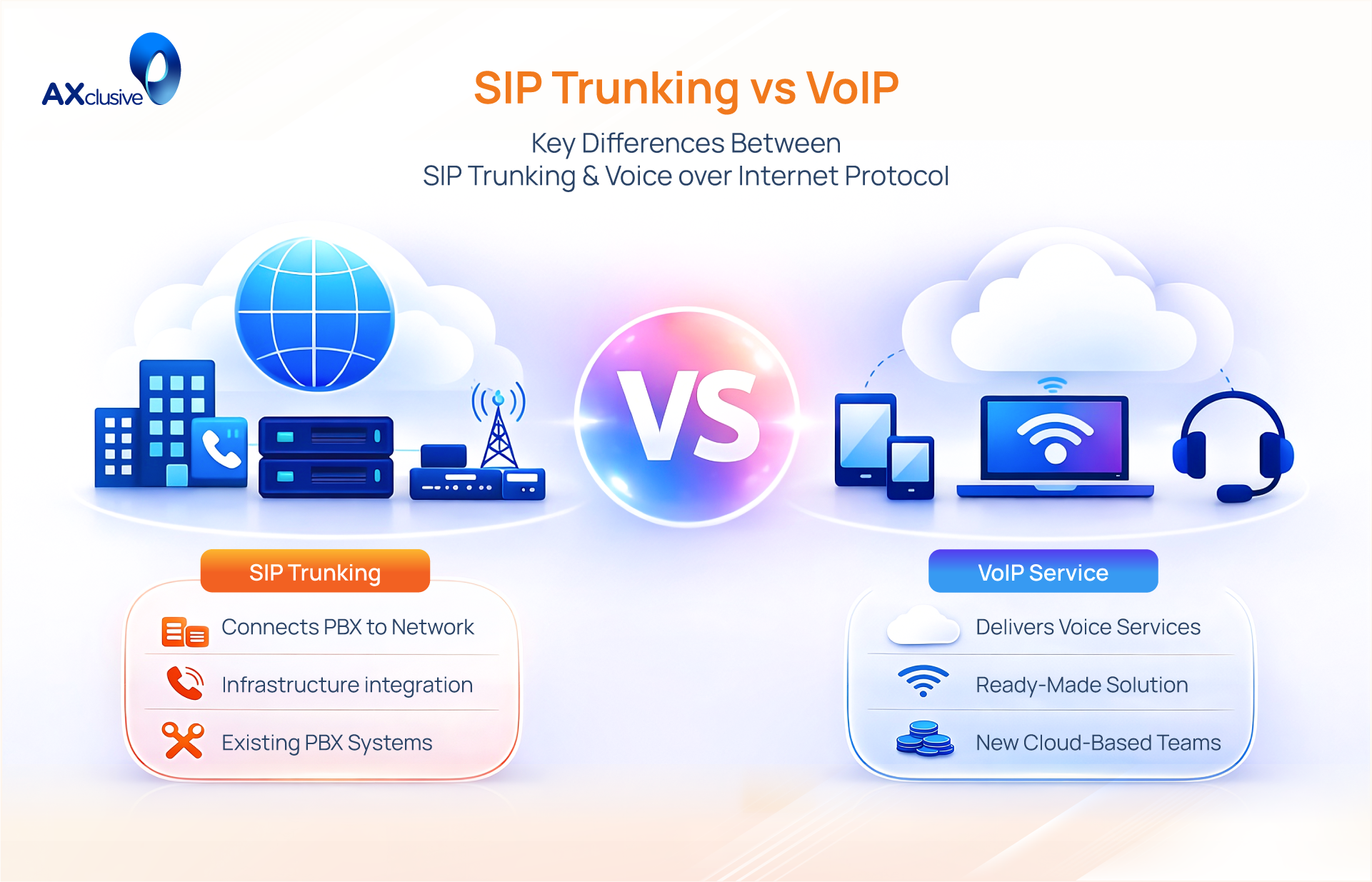
SIP Trunking vs VoIP Key Differences
Understanding the key differences between SIP Trunking vs VoIP is essential for choosing the right communication strategy. While VoIP is the broad technology that enables voice calls over the internet, SIP Trunking is a specific method used to connect on-premise hardware to the global network. One offers a ready-made service, while the other provides the technical foundation for existing infrastructure.
| Feature | Hosted VoIP | SIP Trunking |
|---|---|---|
| Primary Role | A complete, ready-to-use cloud phone system. | A digital connection for an existing PBX system. |
| Management | Managed entirely by the service provider. | Managed internally by your IT team. |
| Equipment | IP Phones, computers, or mobile apps. | Physical or virtual IP-PBX server hardware. |
| Setup | Plug-and-play; very simple. | Complex; requires technical configuration. |
| Control | Limited to provider-defined features. | Total control over routing and security. |
| Pricing | Per-user monthly subscription. | Per-channel (concurrent call) capacity. |
| Maintenance | None; the provider handles updates. | High; requires local server maintenance. |
| Best For | SMBs and remote teams without IT staff. | Large enterprises with existing PBX hardware. |
SIP Trunking vs VoIP Use Cases
Determining the right scenario for sip vs voip depends on your current infrastructure and long-term communication goals. While both technologies transmit voice over the internet, their practical applications differ significantly based on business size and technical requirements.
- Modernizing Legacy Infrastructure: Organizations with functional on-premise PBX hardware use SIP trunking to add modern capabilities. This allows teams to access video conferencing and mobile extensions without replacing their existing physical servers.
- Replacing Aging Analog Lines: SIP trunks serve as the digital replacement for traditional PRI or POTS lines. This migration reduces monthly costs and eliminates the need for expensive copper-wire maintenance by moving voice traffic to a standard internet connection.
- Centralizing Multi-Location Management: Large enterprises with several branch offices use SIP trunking to unify their telecom environment. This centralization simplifies call routing and allows all locations to share a single pool of concurrent call channels, increasing efficiency.
- Connecting Cloud PBX to the PSTN: For businesses using open-source or specialized cloud platforms like 3CX or FreePBX, SIP trunking provides the necessary link to the traditional phone network. It acts as the gateway that allows digital platforms to reach any mobile or landline globally.
- Supporting Rapid Scaling for Small Teams: Hosted VoIP is the primary choice for startups or remote organizations without physical offices. It allows these teams to deploy a professional phone system instantly using only a laptop or mobile app, avoiding any upfront hardware investment.
- Facilitating Unified Communications (UC): Integrating voip and sip allows organizations to merge voice, video, and messaging into one interface. This is common in high-growth companies that need to switch between different communication modes during a single session.
Which Is Better for Your Business SIP Trunking vs. VoIP
Selecting the right communication path requires a careful analysis of your current infrastructure and future growth. There is no one-size-fits-all answer in the sip vs voip debate; rather, the “better” choice is the one that aligns with your technical resources and budget.
Use the following criteria to determine which model fits your business:
- Audit Your Existing Hardware: Evaluate your current telephony assets. If you already own a functional on-premise PBX, SIP trunking allows you to leverage that investment while adding modern cloud features. If you are starting from scratch or have outdated analog equipment, a hosted VoIP solution offers a faster, cloud-native path to connectivity.
- Analyze Call Volume vs. Budget: Review your monthly traffic patterns. SIP trunking is typically more cost-effective for high-volume environments because you pay for concurrent call capacity (channels) rather than individual users. For small teams with lower call volumes, the predictable “per-user” pricing of hosted VoIP often provides a lower total cost of ownership.
- Assess Technical Expertise: Be realistic about your in-house IT capabilities. SIP trunking requires a dedicated network administrator to manage server security, firewall configurations, and software updates. Hosted VoIP is a managed service where the provider handles all backend maintenance, making it the ideal choice for businesses without specialized technical staff.
- Define Required Customization: Determine how much control you need over your communication stack. SIP trunking offers deep customization for complex call routing and high-security requirements. Hosted VoIP provides a standardized feature set that is easier to use but offers less flexibility for unique technical configurations.
- Evaluate Workforce Mobility: Consider where your employees work. Hosted VoIP is inherently designed for remote and hybrid teams, allowing users to connect from anywhere via mobile or desktop apps. While SIP trunking can support remote work, it often requires additional VPN configurations or specialized session border controllers (SBCs) to ensure secure off-site access.
- Plan for Scalability: Consider your growth trajectory. SIP trunking allows you to scale by adding more digital channels to handle increased simultaneous traffic. Hosted VoIP provides superior agility for adding new employees one-by-one, which is beneficial for rapidly growing startups or companies with seasonal staffing needs.
How SIP Trunking vs VoIP Work Together
SIP trunking and VoIP are not competing technologies; they are complementary partners. VoIP provides the actual transmission of voice data over the internet, while SIP acts as the signaling protocol that initiates, manages, and terminates those communication sessions.
Here is how they integrate within a modern network:
- Modernizing Legacy Systems: Businesses use SIP trunks to add VoIP capabilities to on-premise PBX hardware. This allows older physical systems to send and receive digital calls without replacing the entire infrastructure.
- PSTN Connectivity: Cloud-based VoIP systems rely on SIP trunks as a bridge. This trunk connects digital users to the traditional Public Switched Telephone Network (PSTN), allowing internet callers to reach standard landlines and mobile numbers.
- Centralized Communication: Large organizations use SIP to unify multiple VoIP-enabled office locations into a single, managed network. This centralizes external traffic and reduces the cost of maintaining separate phone lines for every branch.
SIP Trunking vs VoIP FAQs
Is SIP trunking VoIP?
Yes. SIP trunking is a specific application of VoIP technology. While VoIP is the broad category of sending voice over the internet, SIP trunking is the method used to connect a physical on-premise phone system to the web. It provides the digital “lines” needed to make VoIP calls possible for traditional hardware.
What Role Does SIP Play in VoIP Calls?
SIP acts as the signaling protocol for the call. It does not carry the actual voice data. Instead, it manages the session by “ringing” the destination, negotiating which audio quality (codec) to use, and ending the connection when a user hangs up. It is the digital manager that sets up the meeting between two callers.
Can VoIP Function Without SIP?
Yes. VoIP can operate using other signaling protocols such as H.323 or MGCP. However, SIP has become the global industry standard because it is lightweight and can handle video, text, and data alongside voice. Most modern voip sip systems choose SIP for its flexibility and wide compatibility.
Are SIP and VoIP the Same Thing?
No. They are related but distinct concepts. VoIP refers to the general service of placing voice calls over an internet connection. SIP is a specific protocol used to initiate and manage those sessions. In the sip trunking vs voip context, think of VoIP as the goal (the phone call) and SIP as the delivery mechanism (the rules that start the call).
Navigating the complexities of sip trunking vs voip is a critical step in modernizing your business communication. Whether you choose the managed simplicity of a cloud VoIP system or the robust control of SIP trunking for your on-premise hardware, both paths lead to significantly lower costs and higher flexibility. This guide from Axclusive provides the technical clarity needed to make an informed decision, ensuring your network remains scalable and ready for the future.
Contact us today to choose between SIP trunking vs VoIP and ensure reliable, scalable business communication.
Back to blog