
PBX vs VoIP in Modern Business Communication
Selecting the right communication system is a critical choice for any modern business. When you evaluate pbx vs voip, you are choosing between traditional hardware and cloud-based technology. One system relies on physical copper wires, while the other uses your internet connection to transmit voice data. This decision impacts your monthly budget, available features, and long-term scalability. Join Axclusive to learn the key differences between these technologies in the article below.
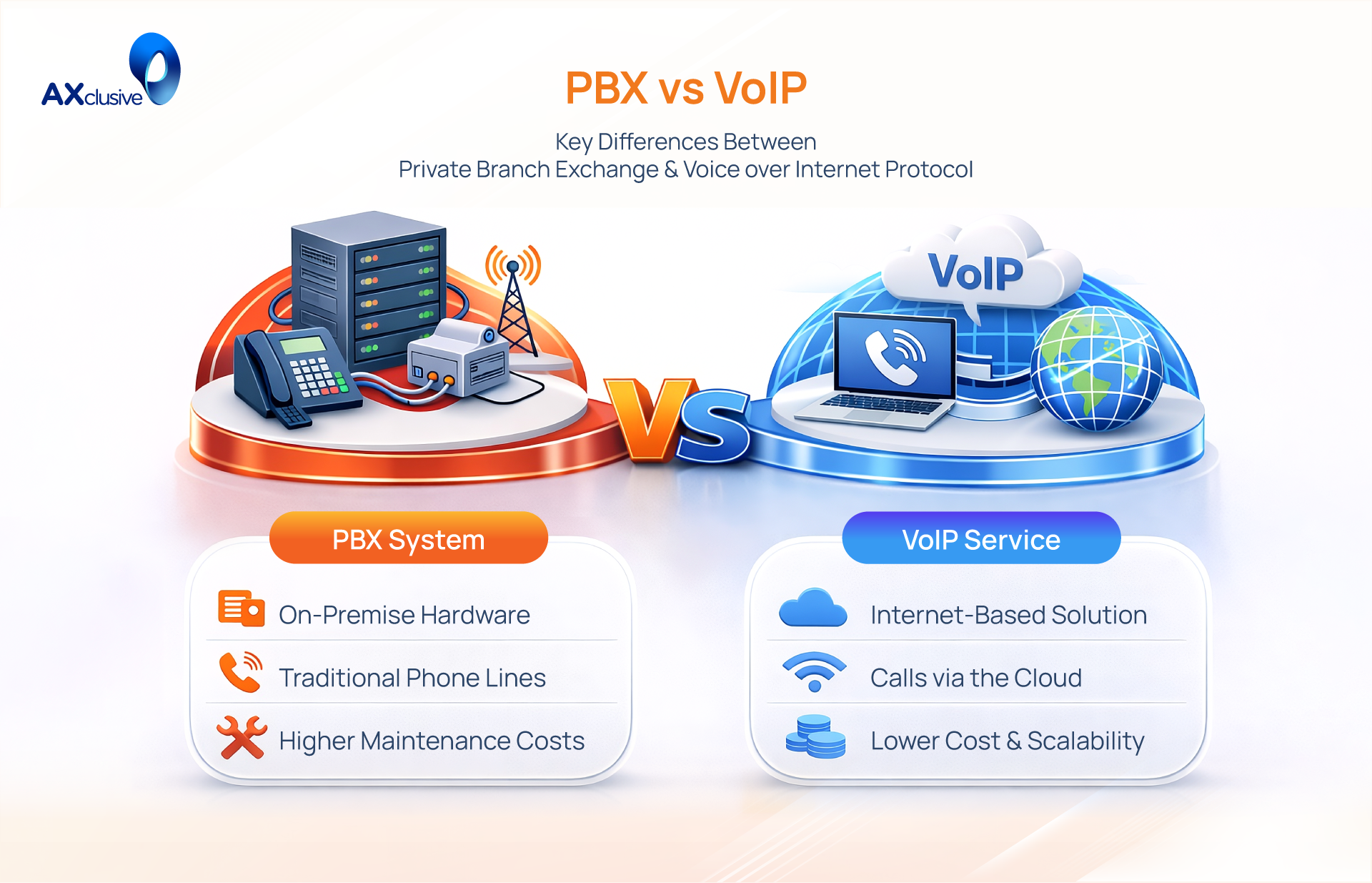
PBX vs VoIP Key Differences
Understanding the technical and operational distinctions between PBX vs VoIP is essential for choosing the right communication infrastructure. While both systems manage business calls, they utilize fundamentally different technologies, affecting everything from monthly costs to daily management.
Connection Method
The primary difference lies in how the signal travels. PBX systems connect via traditional copper landlines or Primary Rate Interface (PRI) circuits. They typically operate on a dedicated voice network, physically separate from your company’s data network.
In contrast, VoIP transmits voice data over your existing internet connection and Local Area Network (LAN). It uses standard Ethernet cables, allowing computers and phones to share the same infrastructure. A typical VoIP call requires approximately 100 kbps of bandwidth per line, making it highly efficient for modern broadband connections.
Cost Structure
PBX follows a Capital Expenditure (CAPEX) model. It requires significant upfront investment for servers, routers, and proprietary desk phones. Ongoing expenses include maintenance contracts and potentially higher monthly fees for landlines.
VoIP operates on an Operational Expenditure (OPEX) model. The upfront costs are low, often limited to purchasing IP phones. Providers charge a monthly subscription fee per user, typically starting between $15 and $25. This fee usually includes domestic calling, PBX features, and support. Switching to VoIP can reduce total communication costs by up to 60%.
Scalability Options
Scaling a PBX system is often complex and costly. Adding new lines usually requires installing new physical hardware, purchasing expansion modules, and running new wiring. This process is slow and difficult to manage across multiple locations.
VoIP offers seamless scalability. Because the system is cloud-based, you can add new users or extensions instantly via a web portal. Expanding requires only the purchase of an additional IP phone or the download of a softphone app. VoIP also unifies multiple office locations under a single plan without complex routing hardware.
Available Features
Both systems offer standard utilities like call forwarding and voicemail. However, VoIP excels in advanced Unified Communications (UC). Standard VoIP plans typically include video conferencing, mobile apps for remote work, instant messaging, and CRM integrations.
PBX systems are often limited to voice features unless you purchase expensive add-on modules. Additionally, VoIP supports a flexible range of hardware, including softphones on laptops and mobile devices, whereas PBX relies heavily on proprietary hardware with limited compatibility.
System Maintenance
PBX systems place the maintenance burden on your internal IT team. You are responsible for server upkeep, software patches, and hardware repairs. This requires specialized telecommunications expertise.
Hosted VoIP is a managed service. The provider handles all backend hardware, software updates, and security patches in the cloud. Technical issues are resolved remotely by the provider’s support team, significantly reducing the need for on-site IT staff and lowering maintenance overhead.
Security Considerations
PBX systems operate offline, making them immune to internet-based cyberattacks. However, they remain vulnerable to physical intrusion and “toll fraud” if an attacker gains access to the local hardware.
VoIP systems transmit data over the public internet, making them susceptible to cyber threats. To mitigate this, reputable providers use robust encryption protocols (like TLS and SRTP) and active network monitoring. When selecting a VoIP vendor, verifying their security compliance is essential to protect your data.
Service Reliability
PBX systems offer high stability because they do not rely on internet connectivity. They function as long as the physical copper lines are intact and power is available.
VoIP reliability is directly tied to the quality of your internet connection and bandwidth. If the internet fails, the phones will go offline. To ensure business continuity with VoIP, it is critical to have a stable internet provider, proper network configuration, and a backup power supply.
What advantage does VoIP offer over PBX?
While traditional PBX systems provide stability, the shift toward Voice over IP (VoIP) is driven by superior agility and cost-efficiency. VoIP modernizes business communication by moving infrastructure to the cloud, offering five distinct advantages that legacy hardware cannot match.
Lower Operating Costs
VoIP significantly reduces the Total Cost of Ownership (TCO). Unlike PBX systems that require expensive server hardware, licensing fees, and specialized installation, VoIP operates on a subscription-based model (OPEX). Businesses avoid the high costs of copper landlines and maintenance contracts, paying only for the users and features they need. This eliminates the financial burden of hardware depreciation and upgrades.
Improved Voice Quality
Modern VoIP technology utilizes wideband audio codecs (often called “HD Voice”) to deliver sound clarity that surpasses traditional analog lines. Provided that the internet connection is stable, VoIP eliminates the static and interference common with aging copper wires. Furthermore, this high-fidelity audio extends to mobile apps, ensuring employees sound professional whether they are in the office or working remotely.
Easier Scalability
VoIP removes the physical barriers to growth. Scaling a PBX system often involves purchasing new line cards, installing expansion modules, and running physical wiring. With VoIP, scaling is virtually instant. Administrators can provision new phone lines and extensions via a web dashboard in minutes, allowing the system to expand or contract seamlessly alongside business staffing levels.
Simplified Management
Managing a traditional PBX requires specialized telecommunications knowledge or expensive vendor support visits. VoIP democratizes system management through user-friendly web portals. IT staff can configure call routing, update firmware, and troubleshoot issues remotely from any location. This ease of management reduces downtime and reliance on third-party technicians.
Greater Feature Flexibility
VoIP offers a suite of Unified Communications (UC) tools that legacy systems cannot support without costly add-ons. Beyond basic call forwarding and voicemail, VoIP integrates video conferencing, instant messaging, and mobile connectivity into a single platform. It also easily integrates with business software like CRMs (Salesforce, HubSpot), allowing for automated call logging and data syncing that streamlines workflows.
PBX vs VoIP Decision Factors
Selecting the right telephony infrastructure involves more than comparing hardware specifications. It requires a strategic analysis of your operational goals. To choose between an on-premise PBX and a cloud-based VoIP solution, evaluate these three critical business criteria.
Business Size and Budget Factors
Your preferred financial model largely dictates the correct choice. PBX systems operate on a Capital Expenditure (CAPEX) model. They require a substantial upfront investment for servers, proprietary phones, and hardwired installation. This often suits large enterprises that prefer owning physical assets and have a budget for long-term hardware amortization.
VoIP solutions function on an Operational Expenditure (OPEX) model. They require minimal initial hardware and rely on a predictable monthly subscription. This structure is ideal for Small and Medium-sized Businesses (SMBs) or startups. It offers a low barrier to entry and allows companies to pay only for the active lines they need, freeing up capital for other investments.
Required Communication Features
Analyze your team’s workflow requirements. If your business operates strictly from a single location and requires only basic voice calling and voicemail, a PBX system provides a stable, no-frills solution.
However, if your organization values mobility and data integration, VoIP is the superior option. VoIP platforms come standard with Unified Communications (UC) tools, including video conferencing, mobile apps for remote work, and CRM integration. While PBX systems can sometimes offer these features, they typically require expensive hardware add-ons or complex third-party software licenses.
Internal IT Capabilities
Assess your technical resources honestly. Managing an on-premise PBX system is technically demanding. It requires a dedicated IT staff capable of maintaining servers, configuring complex routing, and repairing physical line drops.
Hosted VoIP shifts this technical burden to the service provider. The vendor manages all backend infrastructure, security patches, and software updates in the cloud. For businesses without a specialized telecommunications team, VoIP offers a “plug-and-play” experience that ensures professional reliability without the need for in-house maintenance.
FAQ
Are PBX and VoIP the Same Technology?
No. PBX (Private Branch Exchange) refers to the system that routes calls internally within an organization. VoIP (Voice over IP) is the method of transmitting voice data over the internet. While they are distinct, modern systems often combine them into an “IP-PBX,” using internet protocols to manage the phone network.
Does VoIP Still Require a PBX System?
Yes, but it is virtual. VoIP still needs PBX logic to handle extensions and call routing. In Hosted VoIP, the service provider manages the PBX software in the cloud, eliminating the need for businesses to purchase or maintain physical server hardware on-site.
Which is better PBX or Voip ?
For most modern businesses, VoIP is the superior choice due to lower costs, easier scalability, and advanced features like remote work support. Traditional PBX is typically only better for large enterprises that require absolute on-premise control or operate in areas with unreliable internet connectivity.
Is PBX Technology Becoming Obsolete?
Legacy analog PBX hardware is becoming obsolete as telecom carriers retire traditional copper lines. However, the core concept of the private exchange lives on through IP-PBX systems, which have evolved to run on modern VoIP technology.
Deciding between pbx vs voip ultimately defines your business’s future agility and technical resilience. While legacy hardware offers total on-site control, cloud-based VoIP delivers the scalability and advanced features required for a modern, mobile workforce. Axclusive helps you navigate these complex options to ensure your communication infrastructure remains efficient, secure, and cost-effective.
Contact us today to upgrade from PBX to VoIP and improve your communication efficiency.
Back to blog