
What Is VXLAN in Networking?
How do modern cloud providers and large data centers overcome the scalability limits of traditional VLANs? The answer lies in a powerful virtualization technology. To understand it, we must first ask, what is VXLAN? It is the overlay protocol that allows for massive-scale network segmentation over a standard IP infrastructure. Join Axclusive ISP in this article as we explore how VXLAN operates and why it has become the industry standard for cloud networking.
What is VXLAN?
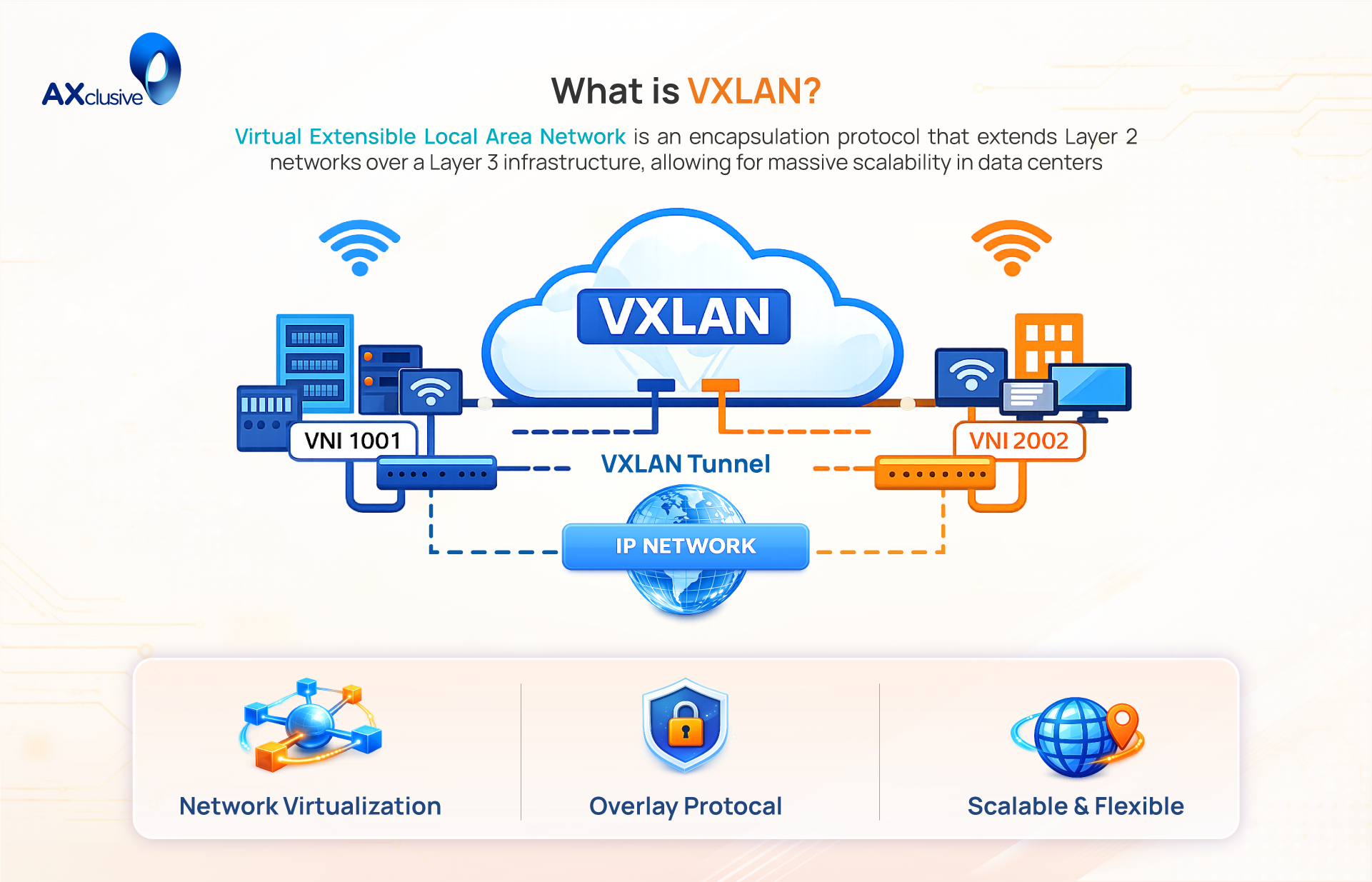
Virtual Extensible LAN (VXLAN) is a network virtualization technology designed to overcome the limitations of traditional VLANs in large-scale and multi-tenant environments. It functions as an overlay technology, creating isolated, logical Layer 2 networks that are tunneled over an existing Layer 3 infrastructure. This approach allows a single physical network to be securely partitioned for thousands of different tenants, similar to how an apartment building provides private, isolated units within a single shared structure. Each VXLAN segment is a discrete virtual network, ensuring traffic from one tenant remains completely invisible to others.
How VXLAN Operates in Network Environments
VXLAN operates by creating a logical Layer 2 overlay network that is tunneled on top of a physical Layer 3 infrastructure (the underlay). This is accomplished through a process called encapsulation. When a device sends an Ethernet frame within a VXLAN segment, a designated network device called a VXLAN Tunnel End Point (VTEP) intercepts it.
The VTEP wraps the original Layer 2 frame inside a UDP packet. It adds a VXLAN header, which includes a 24-bit VXLAN Network Identifier (VNI) to uniquely identify the virtual network segment. This entire package is then placed inside a standard IP packet. This new IP packet is routed across the physical network just like any other traffic. When it reaches the destination VTEP, the process is reversed (decapsulation), and the original Ethernet frame is delivered to the end device, making the underlying transport network completely transparent.
VXLAN Strengths and Limitations
VXLAN offers a powerful solution for modern network virtualization, but its implementation requires a clear understanding of both its advantages and its inherent complexities.
Strengths of VXLAN
- Massive Scalability: The primary advantage of VXLAN is its ability to create over 16 million unique, isolated network segments using a 24-bit VNI. This overcomes the 4,096-segment limit of traditional VLANs, making it essential for large cloud providers and multi-tenant data centers.
- Enhanced Workload Mobility: Because VXLAN creates a logical overlay independent of the physical network, it allows for the seamless migration of virtual machines (VMs) across different physical hosts, racks, or even data centers without needing to change their IP addresses or network configurations.
- Improved Security through Segmentation: The logical isolation provided by VXLAN segments ensures that traffic from one tenant is completely segregated from another, even when running on the same physical hardware. This creates a foundational “zero-trust” environment within the data center.
Limitations of VXLAN
- Increased Overhead and MTU Requirements: The encapsulation process adds approximately 50 bytes of header information to each packet. This requires the underlying physical network to be configured with a larger Maximum Transmission Unit (MTU), or “jumbo frames,” to avoid performance-degrading IP fragmentation.
- Higher Complexity: Designing, managing, and troubleshooting a VXLAN overlay network is more complex than a traditional VLAN-based architecture. It requires engineers to have expertise in both Layer 2 and Layer 3 protocols, as issues can arise in either the overlay or the underlay.
- Control Plane Dependency: For any large-scale deployment, VXLAN requires a sophisticated control plane, typically BGP EVPN, to manage MAC address learning and VTEP discovery efficiently. This adds another layer of protocol management to the network.
VXLAN Implementation Approaches
A successful VXLAN implementation requires careful planning of the underlying physical network and a clear strategy for configuring the overlay. The core of the implementation involves configuring the VXLAN Tunnel End Points (VTEPs), which can be software-based (on a hypervisor) or hardware-based (on a physical switch).
The fundamental process follows these key stages:
- Prepare the Underlay Network: Before configuring any VXLAN settings, the physical network must be ready. This includes establishing a stable Layer 3 IP fabric between all planned VTEP devices and, crucially, ensuring the Maximum Transmission Unit (MTU) is increased network-wide to accommodate the VXLAN header overhead (typically to 9000 bytes or “jumbo frames”).
- Configure VTEPs: On each designated VTEP device, you must enable the VXLAN feature. This involves creating a virtual tunnel interface and assigning it an IP address, which will serve as the source for encapsulated packets.
- Define VXLAN Segments (VNIs): Next, you define the virtual networks by mapping a Layer 2 VLAN or bridge domain to a specific VXLAN Network Identifier (VNI). This mapping tells the VTEP which traffic belongs to which overlay segment.
- Establish the Control Plane: The VTEP needs to know how to reach other VTEPs. In a static configuration, this can be done by manually defining a list of remote peer IP addresses. However, for any dynamic environment, a control plane protocol like BGP EVPN is implemented. This allows VTEPs to automatically discover each other and exchange MAC address reachability information, making the entire overlay scalable and resilient.
VXLAN Deployment Models
The specific model chosen for a VXLAN deployment is defined by the location of the VXLAN Tunnel End Point (VTEP). The VTEP is the device responsible for encapsulation and decapsulation, and its placement determines how traffic enters and exits the overlay network. The decision depends on the network’s scale, the type of workloads (virtual vs. physical), and the need for external connectivity.
Host-Based VXLAN Deployment
In this model, the VTEP functionality resides within the hypervisor on the server host itself, typically as part of a virtual switch. Encapsulation and decapsulation are performed in software before the traffic is placed on the physical network. This approach is ideal for environments with high concentrations of virtual machines (VMs), as it allows for maximum flexibility and mobility. East-west traffic between VMs on different hosts is handled efficiently at the server edge, and the physical network only needs to provide simple IP transport.
Gateway-Based VXLAN Deployment
With this approach, the VTEP is a hardware-based function on a physical network device, such as a top-of-rack switch or a spine router. This device, often called a VXLAN gateway, handles the encapsulation and decapsulation for all connected, non-VXLAN-aware endpoints, like bare-metal servers or traditional VLANs. The primary use case for this model is to provide the critical on/off-ramp between the VXLAN overlay and the external, non-VXLAN world, enabling north-south routing and connectivity.
Hybrid VXLAN Architecture
A hybrid architecture combines both host-based and gateway-based deployments within the same network, which is the most common model in modern data centers. In this design, software VTEPs on the hypervisors handle the highly efficient east-west traffic between virtual machines. Simultaneously, hardware-based VXLAN gateways provide high-performance north-south routing, connecting the virtualized environment to physical servers, legacy networks, and the internet. This approach offers the optimal balance of flexibility, scalability, and performance.
VXLAN is the definitive solution to the scaling challenges of traditional networks. By providing massive scale and workload mobility, it has become indispensable for modern cloud and data center environments. This guide from Axclusive provides the foundational knowledge needed to help you design and deploy a more scalable and resilient network architecture.
🌐 Contact us today to learn more about what is VXLAN and how VXLAN can help scale and simplify modern network virtualization.
Back to blog