
What Is a Session Border Controller? Functions and Benefits
As businesses migrate to IP telephony, securing voice traffic becomes essential. Understanding what is a Session Border Controller helps explain how enterprises protect and manage VoIP communications. Explore more with Axclusive ISP in this article.
What is a Session Border Controller?
A Session Border Controller (SBC) is a specialized network security and traffic management device that governs Voice over IP (VoIP) communications across network boundaries. Functioning as an intelligent gateway between enterprise voice systems and external networks, an SBC manages, secures, and optimizes real-time communication sessions using protocols such as Session Initiation Protocol (SIP) and Real-time Transport Protocol (RTP).
In technical terms, an SBC operates at the session border the demarcation point between trusted internal networks and untrusted external networks providing comprehensive control over signaling and media traffic for voice, video, and unified communications.
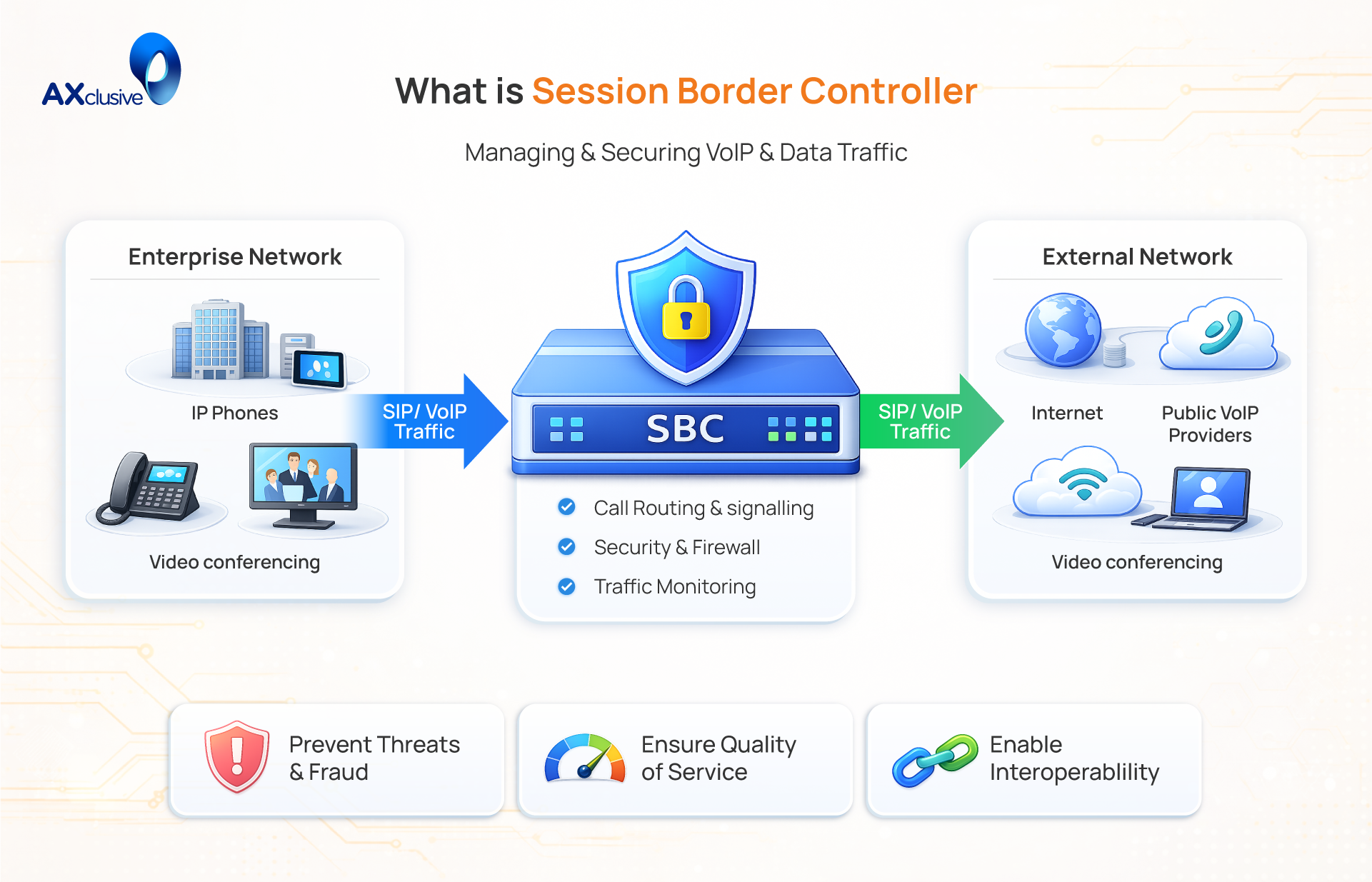
How Do Session Border Controllers Work?
A session border controller places itself directly in the communication path of a VoIP call. It manages both the signaling instructions and the media traffic. The device operates primarily using standard communication protocols like Session Initiation Protocol (SIP), H.323, and MGCP.
The controller acts as a strict middleman to protect the internal network. Engineers call this function a Back-to-Back User Agent (B2BUA). When an outside call arrives, the controller terminates that connection at the network border. It then creates a brand new, separate call leg to the internal destination. This process completely hides the internal network topology from the outside world.
This two-leg setup gives the controller absolute authority over the call. It inspects and controls the call setup data and the actual voice or video stream. The controller can also redirect media traffic to other internal servers. This feature allows the network to handle specialized tasks like call recording or playing music on hold.
Without a controller, voice traffic travels directly between two VoIP endpoints. The central network loses all control over the security, quality, and routing of that media path. The session border controller prevents this by ensuring all traffic passes through a secure, managed checkpoint.
Core Functions of Session Border Controllers
A session border controller does more than just route calls. It serves as the primary defense and optimization engine for your voice network. The device processes complex communication tasks in milliseconds. Network administrators rely on five core functions to keep VoIP systems secure and operational.
Security and Access Control
Session Border Controllers implement multi-layered security mechanisms that protect enterprise voice infrastructure from external threats. Through topology hiding, the SBC conceals internal network architecture from external entities, preventing reconnaissance attacks and unauthorized access. Advanced authentication and authorization protocols verify the legitimacy of every communication session, while encryption capabilities using Transport Layer Security (TLS) for signaling and Secure Real-time Transport Protocol (SRTP) for media ensure confidentiality and integrity of voice communications.
Protocol Interoperability and Normalization
Modern enterprises utilize diverse communication platforms—from legacy PBX systems to cloud-based unified communications services like Microsoft Teams and Zoom. SBCs bridge the technical gap between these heterogeneous systems by normalizing SIP dialects, translating codec formats, and ensuring seamless interoperability across vendor platforms. This protocol mediation eliminates compatibility issues that historically plagued enterprise voice deployments.
Quality of Service Management
Session Border Controllers actively monitor and optimize voice quality through intelligent traffic management. By implementing Quality of Service (QoS) policies, SBCs prioritize voice packets over other network traffic, manage jitter buffers to smooth packet arrival variations, and employ advanced algorithms to minimize latency and packet loss. Real-time analytics provide visibility into call quality metrics, enabling proactive identification and resolution of performance degradation.
Network Address Translation Traversal
In enterprise environments where Network Address Translation (NAT) and firewalls are essential security components, SBCs solve the inherent compatibility challenges these technologies create for VoIP communications. Through sophisticated NAT traversal techniques including Interactive Connectivity Establishment (ICE), Session Traversal Utilities for NAT (STUN), and Traversal Using Relays around NAT (TURN), SBCs ensure reliable media connectivity without compromising network security.
Regulatory Compliance and Lawful Intercept
For organizations operating in regulated industries, SBCs provide essential compliance capabilities. Built-in lawful intercept functionality enables authorized communication monitoring as required by telecommunications regulations, while comprehensive audit logging and session recording support regulatory requirements for financial services, healthcare, and government sectors.
Session Border Controllers vs Traditional Voice Solutions
The migration from legacy copper lines to modern IP networks transforms business communication by merging voice and data. However, this convergence introduces new security risks. A VoIP Session Border Controller (SBC) bridges this gap, delivering the robust protection of traditional systems while unlocking the flexibility of the cloud.
The Traditional Voice Landscape
Legacy enterprise voice systems operate on circuit-switched technology, primarily using the Public Switched Telephone Network (PSTN) and Integrated Services Digital Network (ISDN). These systems rely on dedicated physical copper lines that physically separate voice traffic from data traffic. While this isolation provided predictable call quality, it created a rigid and expensive infrastructure.
Key characteristics of this legacy environment include:
- Hardware Dependence: Scaling requires installing physical lines and purchasing proprietary hardware, leading to high Capital Expenditure (CapEx).
- Operational Silos: Voice and data run on separate networks, doubling the maintenance workload for IT teams.
- Vendor Lock-in: Proprietary systems make it difficult to integrate with third-party applications or switch providers.
- Geographic Limitations: Phone numbers are tied to specific physical locations, making remote work and international expansion costly and complex.
The Modern SBC-Enabled Voice Environment
Modern communications operate on converged IP networks, where voice, video, and data share a single infrastructure. A Session Border Controller is the critical component that makes this possible. It secures the network edge, ensuring that Voice over IP (VoIP) traffic flows safely alongside data without compromising quality. This architecture shifts the focus from physical connectivity to logical management.
The advantages of an SBC-enabled environment include:
- Unified Infrastructure: Voice and data share bandwidth, significantly reducing operational complexity and overhead costs.
- Dynamic Scalability: Organizations can add or remove call channels instantly via software configuration, following a flexible Operational Expenditure (OpEx) model.
- Seamless Interoperability: SBCs normalize protocols, allowing different platforms (like Microsoft Teams, Zoom, and legacy PBXs) to communicate flawlessly.
- Advanced Security: The SBC replaces physical isolation with logical security layers, encrypting traffic and hiding network topology to protect against internet-based threats.
Benefits of Session Border Controllers
Deploying a Session Border Controller (SBC) provides a strategic advantage by transforming your voice network into a secure, efficient, and reliable communication platform. The benefits extend beyond simple call routing to deliver enhanced security, significant cost savings, and a superior user experience, ensuring your infrastructure is both compliant and future-proof.
Enhanced Security and Fraud Prevention
The shift to internet-based telephony expands the attack surface for businesses. SBCs serve as the primary defense against specific threats targeting voice infrastructure.
- Real-time Threat Detection: The system analyzes traffic patterns to identify anomalies, such as sudden spikes in call volume to high-cost destinations, blocking toll fraud before financial damage occurs.
- Granular Access Control: Administrators can enforce strict policies, such as limiting calls to specific geographic regions or capping concurrent sessions per user to prevent abuse.
- DDoS Mitigation: The device distinguishes between legitimate voice packets and malicious flood attacks, ensuring communication lines remain open even during a denial-of-service attempt.
- Data Encryption: Implementation of TLS 1.3 for signaling and SRTP for media ensures that sensitive conversations remain confidential and tamper-proof.
Cost Optimization and Operational Efficiency
Deploying an SBC allows enterprises to move away from rigid legacy pricing models toward flexible, efficiency-driven operations.
- Infrastructure Consolidation: Merging voice and data onto a single IP network eliminates the maintenance costs associated with separate physical lines and legacy hardware.
- Least-Cost Routing: The SBC automatically selects the most economical carrier path for every call based on destination and time of day, reducing international calling expenses.
- Software Scalability: Capacity upgrades are handled through software configurations rather than physical installations, allowing businesses to scale instantly without lead times.
- Automatic Failover: Redundant configurations restore service in seconds during a network failure, minimizing the financial impact of downtime.
Flexibility and Future-Proofing
As communication technologies evolve, the SBC acts as a bridge between legacy hardware and modern cloud platforms.
- Platform Interoperability: It normalizes protocols to connect disparate systems, such as on-premise PBXs, Microsoft Teams, and Zoom, into a single unified environment.
- Remote Work Support: Secure VPN integration and WebRTC capabilities ensure remote employees maintain reliable voice access regardless of their location.
- Hybrid Cloud Migration: The technology supports phased migrations, allowing organizations to move to the cloud gradually while maintaining existing on-premise investments.
- Emerging Tech Compatibility: Native support for APIs and Direct Routing ensures the network is ready for AI integration and future communication standards.
Compliance and Regulatory Adherence
For regulated sectors, the SBC provides the necessary tools to meet strict legal and data protection standards.
- Financial Auditing: Built-in features for lawful intercept and comprehensive logging support the strict audit trail requirements of the banking and trading sectors.
- Healthcare Privacy: Strong encryption and access controls protect patient communications, ensuring full compliance with HIPAA regulations.
- Government Security: Network segmentation and detailed session tracking meet the high-security clearance requirements of defense and government agencies.
- Legal Data Retention: The system integrates with recording solutions to manage data retention policies required for legal privilege and compliance.
Enhanced User Experience and Productivity
Security and cost savings ultimately support the primary goal: clear, reliable communication for end-users.
- Consistent Call Quality: Quality of Service (QoS) policies and jitter buffering eliminate common VoIP issues like robotic audio and dropouts.
- Reduced Latency: Intelligent routing prioritizes voice packets to minimize delay, preventing the frustrating “talk-over” effect during conversations.
- Seamless Mobility: Users retain the same phone number and feature set across devices, whether working from the office, home, or a mobile device.
- High Availability: Redundant architecture ensures 99.99% uptime, keeping voice services operational during maintenance windows or minor network disruptions.
Session Border Controllers in the Singapore Context
Singapore’s position as Asia-Pacific’s telecommunications and financial hub creates unique requirements for enterprise communications:
Regulatory Environment
The Infocomm Media Development Authority (IMDA) mandates specific security and resilience standards for telecommunications services. SBCs deployed in Singapore must support lawful intercept capabilities, maintain comprehensive audit logs, and implement security controls aligned with Cybersecurity Act requirements.
Financial Services Sector
With over 150 financial institutions headquartered in Singapore, the banking and investment sector demands robust, compliant communications infrastructure. Monetary Authority of Singapore (MAS) Technology Risk Management Guidelines specifically address communications security, requirements that properly configured SBCs inherently satisfy.
Multi-National Operations
Singapore serves as regional headquarters for many multinational corporations, requiring communications infrastructure that supports diverse geographic operations. SBCs enable cost-effective international connectivity while maintaining centralized security policies and ensuring consistent user experiences across Asian, European, and American offices.
Smart Nation Initiatives
Singapore’s digital transformation agenda emphasizes secure, reliable digital infrastructure. Enterprise communications leveraging SBC technology align with Smart Nation objectives by enabling secure remote work, supporting digital service delivery, and providing the resilient infrastructure required for critical business operations.
In conclusion, the Session Border Controller is no longer an optional component but a foundational element of any modern enterprise voice network. It provides the essential security, interoperability, and quality of service management required to operate reliably in a converged IP environment. This guide from Axclusive delivers the insights needed to leverage SBCs effectively, ensuring your communications remain secure, compliant, and ready for the future.
📞 Contact us today to learn how a Session Border Controller can secure and optimise your VoIP infrastructure for enterprise performance.
Back to blog