
What Is Peering? Network Interconnection Explained
Are you looking to optimize network latency and reduce transit costs? Understanding what is peering is essential for modern network infrastructure. By enabling direct data exchange between networks, peering improves efficiency and performance. Explore more with Axclusive ISP in this article.
What is peering
Peering is the direct interconnection of two independent networks, typically Autonomous Systems (ASes) such as ISPs or large enterprises, allowing them to exchange traffic without a third-party intermediary. By bypassing complex backbone routes, this method optimizes data flow and significantly reduces latency. Unlike IP Transit, where a network pays for access to the global internet, peering is predominantly a “settlement-free” agreement driven by mutual benefit—similar to neighbors removing a fence to share access rather than paying a toll to visit each other. This strategic arrangement handles over 99% of such connections without financial exchange, serving as the foundational efficiency layer of the modern internet.
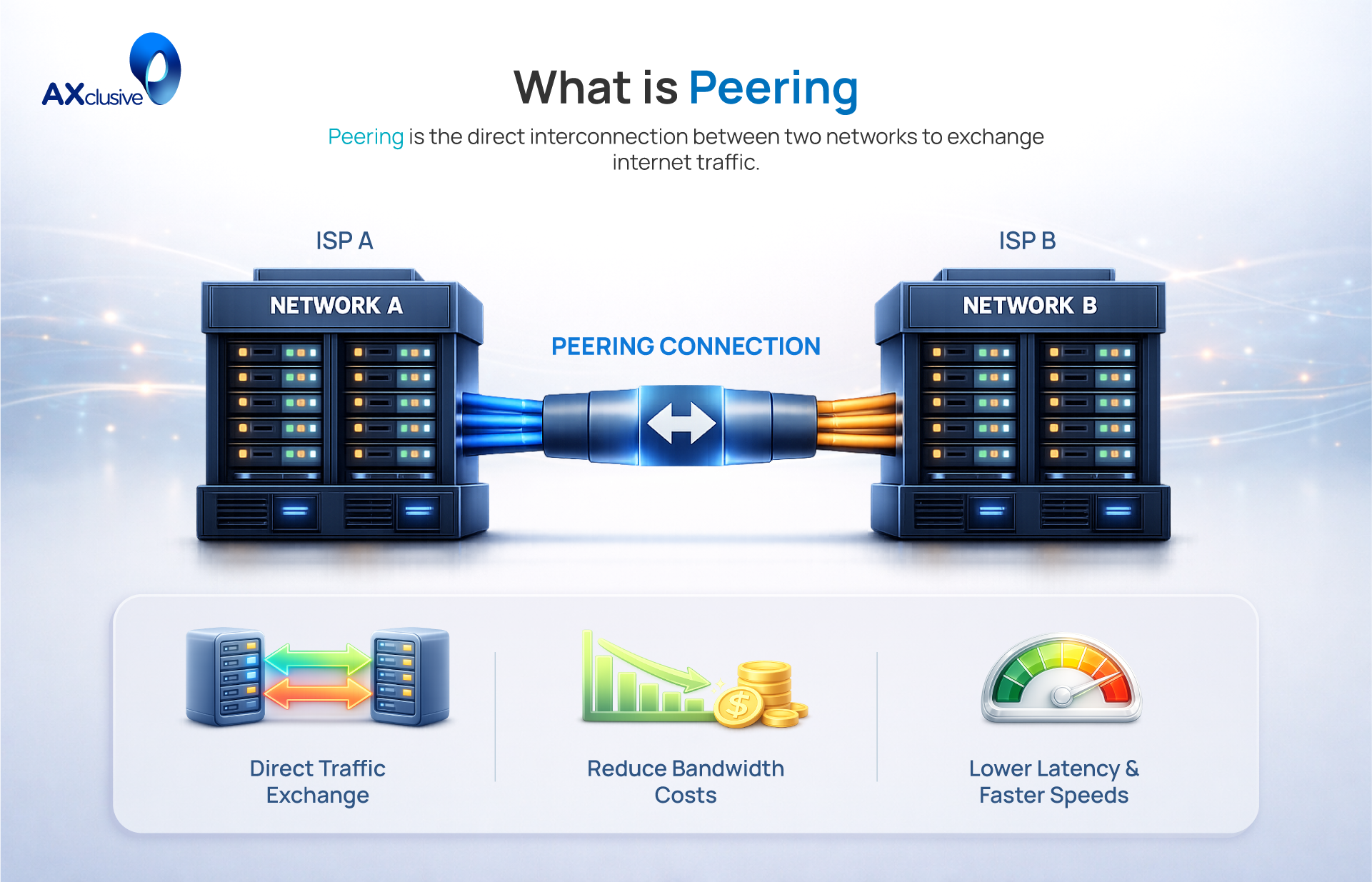
How peering works
Peering functions through a combination of logical protocols and physical infrastructure. On the logical level, it relies entirely on the Border Gateway Protocol (BGP). Networks establish a BGP session to communicate directly. During this session, routers exchange “prefixes”—blocks of IP addresses that belong to them or their downstream customers. Once a prefix is advertised, the connecting router updates its routing table to send traffic for those IP addresses directly to the peer, bypassing third-party transit providers.
Physically, this data exchange happens in carrier-neutral data centers through two primary methods:
- Public Peering: This occurs at an Internet Exchange Point (IXP). An IXP acts like a massive local area network (LAN) using high-performance switches. Networks connect a single router port to the IXP’s switching fabric. This allows them to establish BGP sessions and exchange traffic with dozens or hundreds of other networks simultaneously over that single physical connection.
- Private Peering: Known as Private Network Interconnection (PNI), this method is used for high-volume traffic. Instead of sharing a switch, two networks run a direct fiber optic cable (cross-connect) between their respective routers. They configure BGP across this dedicated link, ensuring that the bandwidth is reserved exclusively for their mutual traffic.
How to set up peering
Setting up peering requires specific administrative assets and physical infrastructure before configuring the software layer. Follow these core steps to establish a connection.
Acquire Essential Resources
You must act as an independent network entity. This requires an Autonomous System Number (ASN) and your own block of public IP addresses (prefixes). These are assigned by Regional Internet Registries (like APNIC, RIPE, or ARIN). Without an ASN, you cannot participate in BGP routing.
Establish the Physical Connection
The Border Gateway Protocol (BGP) manages the logical connection, but it requires a physical path to function. Choose one of these three common methods to reach your peers:
- Data Center Colocation: Install your networking equipment in a carrier-neutral data center that hosts Internet Exchange Points (IXPs). You connect directly via a cross-connect within the facility.
- Metro Fiber Extension: If your equipment is in an office or a private facility, lease a dark fiber or metro ethernet circuit to connect to the nearest IXP or major peering hub.
- Virtual Peering: Use a virtual transport service (often provided by software-defined interconnection platforms) to connect to an IXP or cloud provider remotely, utilizing your existing physical access port.
Configure BGP Sessions
Once the physical link is active, configure BGP on your router. You will define the peer’s ASN and IP address. The specific BGP filters you apply distinguish this connection as a “peering” link rather than a standard “transit” link. This ensures your router only exchanges traffic destined for that specific peer, rather than sending all internet traffic through them.
Peering Impact on Cloud Performance
Peering fundamentally changes the physics of cloud connectivity by replacing the “best-effort” nature of the public internet with a deterministic path. When an organization relies on standard internet transit, data travels across multiple intermediary networks to reach cloud providers like AWS, Azure, or Google Cloud. Each “hop” between these networks introduces variables such as latency, packet loss, and jitter, which degrade the performance of real-time applications.
Direct peering eliminates these intermediaries. By establishing a direct physical and logical link with the cloud provider, traffic bypasses public congestion points completely. This results in consistent, low-latency connectivity essential for sensitive workloads like VoIP, financial trading, or heavy database synchronization. Furthermore, peering offers significant economic advantages. It shifts heavy traffic loads away from expensive metered transit links and often qualifies for reduced cloud data egress fees, lowering the total cost of cloud operations while simultaneously boosting reliability.
Peering Models and Types
Peering agreements are categorized based on how the networks physically connect and the financial terms of the relationship.
- Public Peering: Public peering takes place at an Internet Exchange Point (IXP). Networks connect their equipment to a central switch shared by many other organizations. This model allows a network to peer with dozens or hundreds of different partners using a single physical port, making it highly efficient for managing multiple connections.
- Private Peering: Private Network Interconnection (PNI) is a direct physical connection between two specific networks, usually via a dedicated fiber optic cable. Unlike public peering, it does not use a shared switch. PNI is typically utilized when two networks exchange massive amounts of traffic that would overwhelm a standard public peering port.
- Settlement-Free Peering: This is the traditional “barter” model of the internet. Both parties agree to exchange traffic without charging each other. The arrangement is based on mutual benefit, where the value of traffic exchanged is roughly equal. Each side pays only for its own equipment and cabling, with no recurring fees for the data flow itself.
- Paid Peering: Paid peering occurs when the traffic exchange is not mutually beneficial, often due to a large imbalance in volume. One network pays the other for access to their specific customer base. Unlike IP Transit, which provides access to the entire internet, paid peering is strictly limited to reaching destinations within the provider’s own network.
Benefits of Network Peering
Implementing network peering provides strategic advantages for infrastructure stability and cost management:
- Cost Efficiency: Peering directly reduces operational expenses by offloading traffic from paid IP Transit connections. By routing data through settlement-free peering links, organizations avoid the per-megabit metering charges associated with standard upstream carriers.
- Optimized Performance: Direct interconnection establishes the shortest possible path between networks. This minimizes the number of intermediate “hops” and reduces physical distance, leading to lower latency and a faster, more responsive experience for end-users.
- Greater Resilience: A robust peering strategy diversifies connectivity, reducing reliance on any single transit provider. If a primary internet upstream suffers an outage, peering links remain active, ensuring that traffic to partner networks continues to flow without interruption.
In conclusion, mastering network interconnection is vital for building a faster, more cost-effective digital infrastructure. Axclusive hopes this guide has provided a clear and practical answer to “what is peering,” equipping you with the knowledge to leverage its benefits. By implementing these strategies, organizations can significantly enhance connectivity performance and ensure a more resilient network presence.
Back to blog