
What Is Network Layer in the OSI Model?
How do data packets navigate the complex web of the internet to reach your screen? The answer lies in understanding what is the network layer. Serving as the backbone of the OSI model, Layer 3 is responsible for the logical addressing and routing that makes global communication possible. Join Axclusive ISP below as we decode the core functions, operations, and critical importance of this essential networking component
What is network layer?
The network layer is the third level of the Open Systems Interconnection (OSI) model, responsible for facilitating data transfer between two different networks. It serves as the backbone of the Internet by managing logical addressing and routing through protocols like the Internet Protocol (IP). While devices on the same Local Area Network (LAN) can communicate directly, the network layer is essential when a message must travel to a destination on a separate network. It ensures data packets are correctly addressed, routed, and delivered across multiple network boundaries to reach their final destination.
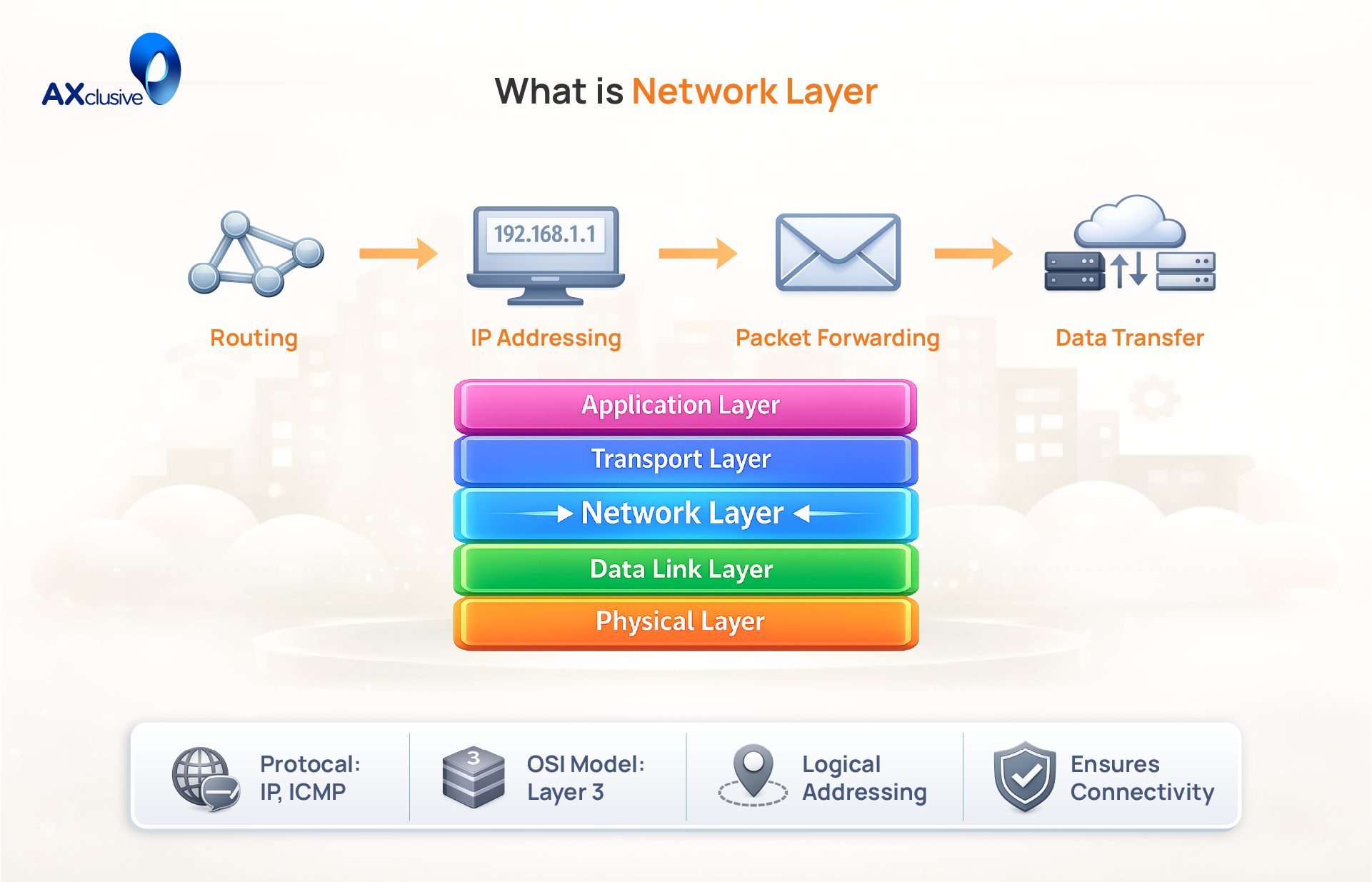
Core Functions of the Network Layer
The network layer executes several critical processes to ensure data traverses complex network topologies successfully.
- Logical Addressing: This layer assigns a unique identifier (IP address) to every device. Unlike physical MAC addresses, these logical addresses are hierarchical, allowing routers to identify the specific network and host location of a destination.
- Routing: This is the process of path selection. Using complex algorithms and protocols, the network layer determines the most efficient route for data to travel from source to destination across multiple interconnected networks.
- Packetization (Encapsulation): The layer receives data segments from the Transport Layer and adds a header containing source and destination IP addresses. This process converts the data into “packets” ready for transmission.
- Forwarding: While routing determines the path, forwarding is the physical action. Routers move packets from an inbound interface to the correct outbound interface based on the destination IP listed in the routing table.
- Fragmentation and Reassembly: If a packet is too large for the destination network’s Maximum Transmission Unit (MTU), the network layer splits it into smaller fragments. These pieces are then reassembled by the receiving device.
- Traffic Management (Subnetting & NAT): This layer organizes networks efficiently. Subnetting divides large networks into manageable segments to control traffic flow, while Network Address Translation (NAT) maps private local addresses to public global addresses to conserve IPv4 space and enhance security.
How the Network Layer Operates
The network layer operates by orchestrating the end-to-end delivery of data through a logical sequence of encapsulation and routing. The process begins when the source device encapsulates transport layer segments into packets, attaching unique source and destination IP addresses. As these packets traverse the infrastructure, routers analyze the destination headers to calculate the optimal path, forwarding the data hop-by-hop across various network links. To accommodate different physical media, this layer automatically fragments packets that exceed a specific link’s Maximum Transmission Unit (MTU) and reassembles them upon arrival. Throughout transmission, protocols like ICMP monitor connectivity, sending error reports back to the source if a destination becomes unreachable, ensuring reliable communication across complex network topologies.
Why is the network layer important?
The network layer is the fundamental enabler of global internet connectivity. Without it, computers would be restricted to communicating only within their local immediate networks. Its importance lies in four critical capabilities that maintain the stability and scale of the internet:
- Global Reach and Interoperability: It bridges diverse network technologies. This layer allows a smartphone on a Wi-Fi network to seamlessly exchange data with a server on a fiber-optic backbone, treating distinct underlying infrastructures as a unified system.
- Intelligent Path Selection: Through complex routing algorithms, this layer dynamically calculates the most efficient path for data. It navigates around network congestion and hardware failures to ensure delivery speeds are optimized.
- Scalable Addressing: By managing logical IP schemes, the network layer provides the hierarchical structure necessary to organize billions of devices. This prevents routing tables from becoming unmanageable and keeps the internet scalable.
- Security and Reliability: It acts as the foundation for secure communication protocols like IPsec and VPN tunneling. Additionally, it ensures data integrity by handling packet fragmentation and reassembly when traversing networks with different capacity limits.
Network Layer in the OSI Model
The Open Systems Interconnection (OSI) model organizes network communication into seven distinct layers. The Network Layer sits at Layer 3, acting as the critical bridge between the hardware-focused “media layers” (Layers 1-2) and the software-focused “host layers” (Layers 4-7).
In this hierarchy, the Network Layer is the engine for inter-network connectivity. While Layer 2 handles data movement within a single Local Area Network (LAN), Layer 3 is responsible for routing data packets across the internet to different networks.
Here is how the Network Layer interacts within the stack:
- Upper Layers (5-7 – Session, Presentation, Application): these layers focus on user data, encryption, and application sessions.
- Layer 4 (Transport): Ensures reliable data delivery and breaks data into segments. It passes these segments down to the Network Layer.
- Layer 3 (Network): Encapsulates segments into packets. It adds logical addressing (IP) and determines the best routing path. It then passes the packet down to the Data Link layer.
- Layer 2 (Data Link): Encapsulates packets into frames (using MAC addresses) for local delivery between directly connected nodes.
- Layer 1 (Physical): Transmits the raw binary bit stream over physical cables or wireless signals.
Network Layer in the TCP/IP Model
The TCP/IP model, also known as the Internet Protocol Suite, streamlines network architecture into four layers. In this practical framework, the duties of the OSI Network Layer are performed by the Internet Layer.
The Internet Layer is central to the stack. It focuses solely on logical addressing and routing, ensuring data can traverse multiple networks to reach a final destination.
Here is the breakdown of the TCP/IP structure:
- Application Layer: Combines the OSI Application, Presentation, and Session layers. It manages high-level user protocols such as HTTP, SMTP, and DNS.
- Transport Layer: Corresponds directly to the OSI Transport layer. It ensures reliable host-to-host communication using TCP (Transmission Control Protocol) and UDP (User Datagram Protocol).
- Internet Layer (Network Layer Equivalent): This layer handles IP addressing, packet routing, and fragmentation. It utilizes core protocols like IP (Internet Protocol), ICMP (Internet Control Message Protocol), and ARP (Address Resolution Protocol).
- Network Access Layer: Merges the OSI Physical and Data Link layers. It manages the physical transmission of data frames onto the specific network media (like Ethernet cables or Wi-Fi signals).
FAQ
What processes are performed within the network layer?
The network layer is responsible for logical addressing, routing, and encapsulation. It assigns unique IP addresses to data packets to identify their source and destination. Furthermore, it runs routing algorithms to determine the most efficient path across the internet and manages fragmentation, which splits large packets into smaller units to fit the bandwidth constraints of different network links.
How the network layer compares to the Internet layer in networking models?
These terms refer to the same functional level but belong to different architectural models. The Network Layer is Layer 3 in the seven-layer OSI model. The Internet Layer is the direct equivalent in the four-layer TCP/IP model. Despite the different names, both layers perform the exact same core duties: managing IP addressing and routing packets between distinct networks.
What is layer 1, layer 2, and layer 3 in networking?
These layers form the foundation of data transmission. Layer 1 (Physical) handles the hardware and electrical signals, such as cables and radio waves. Layer 2 (Data Link) manages data transfer between devices on the same local network using MAC addresses and switches. Layer 3 (Network) connects those local networks together, using logical IP addresses and routers to deliver data across the global internet.
Is a router a network layer?
Yes, a router is defined as a Network Layer (Layer 3) device. While it has physical ports (Layer 1) and uses Ethernet frames (Layer 2), its primary function occurs at Layer 3. Routers read the logical IP address information inside a packet’s header to make forwarding decisions, distinguishing them from switches, which operate primarily at Layer 2.
In summary, a thorough understanding of the Network Layer is essential for any professional in IT and network administration. This foundational layer not only ensures data is routed correctly but also dictates the performance of global communications. Axclusive trusts this guide has provided you with the clarity needed to confidently build, manage, and optimize your network infrastructure.
🌐Contact us today to learn how a well-designed network layer can improve performance, routing efficiency, and enterprise connectivity.
Back to blog