
What Is MPLS? How MPLS Works in Modern Networks
Understanding what is MPLS helps clarify how enterprises build reliable, high-performance connectivity across wide area networks. Multiprotocol Label Switching enables traffic to follow predefined paths, supporting stable performance for voice, video, and critical business applications. Join Axclusive ISP as we explore how MPLS works and its role in modern enterprise networks in the article below.
What Is MPLS Networking?
Multiprotocol Label Switching (MPLS) is a traffic-forwarding technique used to establish predictable, high-performance connections across wide area networks (WANs). Introduced in the late 1990s, MPLS improves traditional packet routing by directing data along pre-defined paths rather than relying on hop-by-hop routing decisions at each router.
In an MPLS network, packets are assigned short labels that identify the forwarding path they should follow through the provider’s network. Routers use these labels to move traffic efficiently without repeatedly analyzing destination IP addresses. This approach enables consistent routing behavior, reduced latency, and improved reliability—making MPLS well suited for connecting geographically distributed branch offices within enterprise WANs.
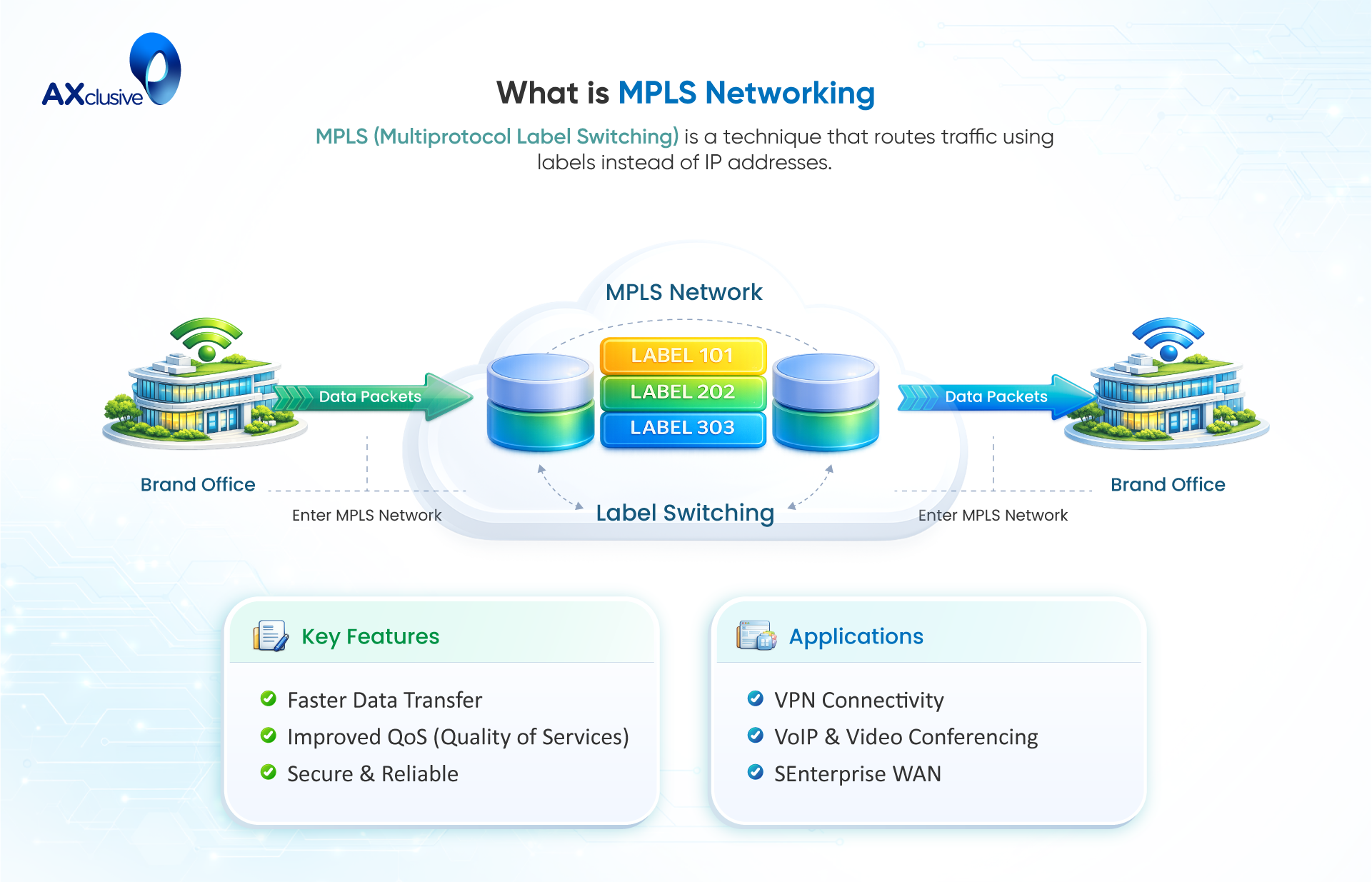
How does routing work in MPLS?
In IP-based networks, data transmitted between devices is broken into small units called packets, rather than being sent as a single continuous stream. Each packet includes a header containing essential routing information, such as the source and destination IP addresses, allowing the network to identify where the data originates and where it must be delivered.
To reach its destination, a packet is forwarded step by step across interconnected networks. At each stage, a router examines the packet’s header and consults its routing table to determine the most appropriate next hop. This process is repeated across multiple routers until the packet reaches the network responsible for the destination IP address, where it is then delivered to the intended device.
This hop-by-hop routing model underpins most Internet communications and provides flexibility and scalability at a global scale. However, in scenarios where organizations require greater control, predictability, or reliability—such as connecting branch offices, campuses, or remote sites—alternative routing approaches may be preferred to ensure consistent performance and managed network paths.
When MPLS Is Appropriate
MPLS has traditionally been deployed as a foundation for enterprise wide area networks (WANs), enabling organizations to connect geographically distributed branch offices, campuses, and operational sites to centralized data centers or headquarters. This model provides reliable connectivity for accessing internal systems and business-critical applications across multiple locations.
Despite its stability, MPLS-based WANs are often expensive to operate, complex to manage, and slow to adapt to changing business needs. Their reliance on fixed routing paths frequently forces traffic to traverse centralized hubs, which can introduce latency, congestion, and inefficiencies—particularly as cloud adoption, remote work, and connected devices continue to grow.
As a result, many organizations are modernizing their WAN architectures. Alternatives such as managed software-defined WAN (SD-WAN) solutions offer greater flexibility, improved cost efficiency, and simplified scalability. More recently, secure access service edge (SASE) architectures have emerged, combining networking and security into a unified cloud-based model that better supports cloud services, hybrid workforces, and distributed enterprise environments.
MPLS advantages and disadvantages
Advantages of MPLS
- Supports multiple network protocols and transport technologies, including IP, Ethernet, ATM, and Frame Relay, within a single MPLS network.
- Enables stable label-switched paths (LSPs) that allow consistent traffic flow across different transmission mediums.
- Provides low and predictable latency, making it suitable for real-time applications such as voice and video communication.
- Delivers high reliability for business-critical data that requires consistent performance and minimal packet loss.
- Allows voice, data, and application traffic to coexist on the same MPLS infrastructure without interference.
- Supports traffic prioritization by assigning different service levels to different types of data.
- Enables bandwidth control by reserving defined portions of capacity for specific applications or services.
- Scales effectively by allowing additional bandwidth to be provisioned as demand increases.
Disadvantages of MPLS
- Involves higher costs compared to internet-based connectivity due to guaranteed performance and strict service-level agreements.
- Relies on private circuits, which require significant time and resources to deploy, modify, or expand.
- Lacks centralized control for rapid configuration or deployment of new locations.
- Is primarily designed for point-to-point or hub-based connectivity, limiting flexibility in cloud-centric architectures.
- Requires dedicated physical infrastructure and can only operate in locations where that infrastructure is available.
- Is not well suited for edge locations, remote users, or direct access to cloud and SaaS applications.
MPLS Connectivity Alternatives
MPLS alternatives are networking options that replace or complement MPLS to reduce cost and increase flexibility. They are commonly used to support cloud access, remote users, and modern application traffic.
MPLS vs. Internet Connectivity
MPLS and public Internet connectivity are both widely used options for enterprise networks, but they are designed to meet different operational requirements. While the Internet offers flexibility and lower cost, MPLS focuses on controlled performance and predictable service delivery. Below is a clear comparison that highlights the key differences between the two approaches.
- Network ownership and routing control: MPLS services are delivered through a single service provider that manages routing across a private backbone. Internet connectivity relies on multiple carriers and public routing paths, where traffic control is not centralized.
- Traffic prioritization: MPLS networks support traffic classification and prioritization, ensuring critical data receives guaranteed handling. Internet connections treat most traffic equally, with no native quality-of-service guarantees.
- Support for voice and video: MPLS is commonly used for voice and video workloads because it provides consistent latency and packet delivery. Internet-based connectivity may experience jitter and packet loss, which can affect real-time communication quality.
- Service-level agreements (SLAs): MPLS includes defined SLAs covering uptime, latency, and packet loss. Internet SLAs are generally less strict and vary by provider and service type.
- Cost structure: MPLS connectivity comes at a higher cost due to managed performance and guaranteed service levels. Internet connectivity is typically more affordable and easier to scale.
- Security model: MPLS operates over private networks that are isolated from public traffic, reducing exposure. Internet connectivity uses public infrastructure and requires additional security controls to protect data in transit.
MPLS vs VPN
MPLS and virtual private networks (VPNs) are both used to connect users and sites securely, but they are built on different network models and serve different operational goals. MPLS focuses on controlled routing and performance, while VPNs emphasize encryption and secure access over public networks. The key differences are outlined below.
- Network foundation: MPLS operates over a service provider’s private backbone with managed routing paths. VPNs run on top of the public internet and create a secure tunnel between endpoints.
- Performance and speed: VPN connections can use high-speed internet links at a lower cost, making them suitable for high-throughput use cases. However, performance depends on internet conditions. MPLS delivers more consistent latency and reliability due to controlled routing.
- Security approach: MPLS networks are logically isolated and use private routing, but encryption is not enabled by default. VPNs are designed around security and always use authentication and encryption to protect data over untrusted networks.
- Encryption and authentication: VPNs rely on established cryptographic methods and tunneling protocols to ensure confidentiality and data integrity. Even if traffic is intercepted, encrypted data remains unreadable. MPLS typically requires additional security layers to achieve the same level of protection.
- Data protection model: VPNs protect data through encrypted tunnels and user authentication, making unauthorized access difficult. MPLS relies on network isolation rather than encryption for data protection.
- Cost and deployment: VPN solutions are generally more cost-effective and easier to deploy, as they do not require dedicated infrastructure. MPLS involves higher costs due to provider-managed circuits and infrastructure commitments.
MPLS vs IPsec
MPLS and IPsec address different aspects of enterprise connectivity. MPLS is designed to provide controlled routing and predictable performance over private networks, while IPsec focuses on securing data transmission across public networks through encryption and authentication. The main distinctions between the two are outlined below.
- Core purpose: MPLS delivers private, provider-managed connectivity with predefined routing paths. IPsec is a security framework that protects IP traffic and is commonly used to build VPN tunnels over the public internet.
- Encryption model: MPLS does not apply encryption by default because traffic remains within a private carrier network. IPsec encrypts every packet and verifies its source, ensuring confidentiality and data integrity during transmission.
- Cost considerations: MPLS requires dedicated infrastructure and service provider contracts, which increases overall cost. IPsec requires tunnel creation between network endpoints, increasing processing load on security devices and operational effort as the network grows.
- Security exposure: MPLS relies on network isolation for protection. While generally secure, traffic could be intercepted by parties with physical access to the link. IPsec traffic is always encrypted, but it travels over public networks where interception attempts are more common.
- Reliability and stability: MPLS services include service-level agreements that emphasize uptime and consistent performance. IPsec depends on internet connectivity, which may experience congestion, packet loss, or route changes.
- Quality of service (QoS): MPLS natively supports traffic prioritization, making it suitable for voice and latency-sensitive applications. IPsec can support QoS at the edge, but performance is ultimately constrained by the public internet.
MPLS vs SD-WAN
MPLS and SD-WAN are both used to build wide area networks, but they are based on different architectural principles. MPLS relies on provider-managed private circuits, while SD-WAN uses software-based control to route traffic across multiple link types. The key differences are outlined below.
- Traffic control and routing logic: SD-WAN uses centralized policies to steer application traffic dynamically across available links. Routing decisions adapt in real time based on performance and policy rules. MPLS uses predefined routing paths managed by the service provider.
- Bandwidth utilization and scalability: SD-WAN can aggregate multiple connections, such as broadband, fiber, and MPLS, to maximize available bandwidth. Capacity can be increased by adding new links. MPLS scaling requires provisioning additional private circuits, which increases cost and deployment time.
- Cloud and internet access: SD-WAN enables direct access from branch locations to cloud services and the internet. This reduces latency and avoids unnecessary traffic redirection. MPLS typically follows a hub-and-spoke model, where traffic is routed through a central data center before reaching external destinations.
- Network backhauling: SD-WAN minimizes backhauling by creating optimized paths between branches, data centers, and cloud platforms. MPLS often backhauls traffic to central hubs, increasing delay and consuming reserved bandwidth.
- Cost efficiency: SD-WAN lowers overall WAN cost by combining internet links with private connections and assigning traffic based on sensitivity. MPLS incurs higher costs due to dedicated infrastructure and performance guarantees.
- Security approach: MPLS relies on private network isolation for security. SD-WAN secures traffic using encryption and secure tunnels across public networks.
MPLS FAQs
Is MPLS a LAN or WAN?
MPLS is a WAN technology. It is used to connect geographically distributed locations, such as branch offices and data centers, over long distances.
What is the difference between MPLS and VPN?
MPLS uses private, provider-managed network paths with predictable performance, while VPNs typically run over the public internet and rely on encryption for security rather than guaranteed routing paths.
What is MPLS for dummies?
MPLS is a way to send data across a network using fixed, predefined paths so traffic arrives faster and more reliably, especially between multiple business locations.
How does MPLS optimize network traffic?
MPLS optimizes traffic by directing data along predetermined paths, reducing routing decisions, minimizing congestion, and improving performance consistency for critical applications.
Multiprotocol Label Switching (MPLS) plays an important role in enterprise networking where performance, reliability, and traffic control matter. Through an introductory article by Axclusive on MPLS, the technology is presented as a strategic connectivity solution that enables predictable performance, optimized traffic flow, and stable communication for complex enterprise network environments.
Back to blog