
What Is Internet Protocol (IP) in Networking?
Understanding what is Internet Protocol explains how devices communicate across networks and the internet. Internet Protocol ensures data is addressed and delivered correctly, forming the foundation of modern digital communication. Join Axclusive ISP to learn more in the article below.
What is Internet Protocol (IP)?
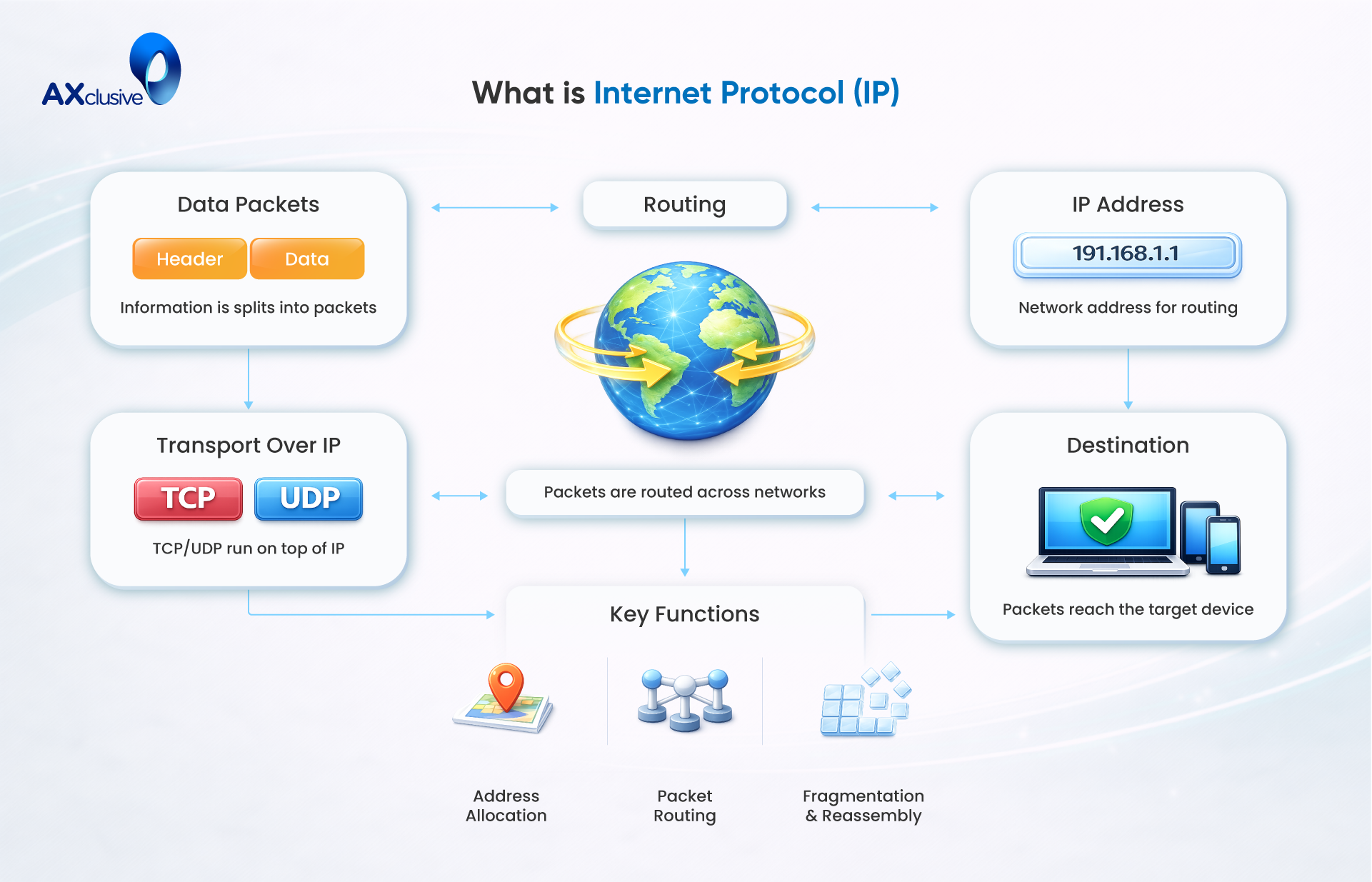
The Internet Protocol (IP) is a foundational networking standard that defines how data is identified, addressed, and routed across interconnected networks. IP works by dividing data into small units called packets and attaching addressing information to each packet. This information allows routers to determine the correct path and deliver packets to their intended destination. Every device or domain connected to the internet is assigned a unique IP address, which ensures that data reaches the correct system.
After packets reach their destination, their handling depends on the transport protocol used alongside IP. The most widely used transport protocols are Transmission Control Protocol (TCP) and User Datagram Protocol (UDP). These protocols manage how data is delivered, checked, or processed after routing is complete, allowing IP to focus solely on efficient and scalable data movement.
What is a network protocol?
In networking, a protocol is a defined and standardized set of rules that governs how data is structured, transmitted, and interpreted between devices. These rules ensure that systems can communicate reliably, even when they are built by different vendors or operate on different platforms. Without protocols, devices would not be able to correctly interpret the data they receive.
Network protocols work by enforcing a consistent format and order for information. Each data packet must include specific details arranged in a predictable structure so that receiving systems know how to process it. This standardization is critical for accurate routing, delivery, and interpretation of data. In the context of Internet Protocol (IP), both packet structure and IP address formatting follow strict standards, allowing global networks to function efficiently and consistently.
What is an IP address?
An IP address is a unique numerical label assigned to a device, server, or domain that participates in an IP-based network. It serves as a logical identifier that allows systems to locate and communicate with one another across the Internet or private networks. IP addresses are expressed in standardized formats—such as the familiar dotted-decimal notation used in IPv4—to ensure consistency and interoperability.
To simplify user access, Domain Name System (DNS) services translate human-readable domain names into their corresponding IP addresses, eliminating the need for users to remember numerical values. During data transmission, each IP packet includes both the source and destination IP addresses, enabling routers to correctly forward packets to their intended endpoints. This addressing mechanism is fundamental to reliable data delivery in modern network communications.
How does IP addressing work?
The global Internet consists of multiple interconnected large-scale networks, each managing specific ranges of IP addresses. These networks, referred to as autonomous systems (AS), operate under independent administrative control and are responsible for routing traffic within their assigned address spaces.
To move data between autonomous systems, the Internet relies on standardized routing protocols—most notably the Border Gateway Protocol (BGP). Routers use these protocols to exchange routing information and build routing tables that determine the most efficient paths for forwarding packets toward their destination IP addresses. As packets traverse the network, they are passed from one autonomous system to another based on these routing decisions.
Once a packet reaches the autonomous system that owns the destination IP range, that network handles the final stage of delivery, routing the packet internally to the specific device or service endpoint. This hierarchical and cooperative routing model enables the Internet to scale globally while maintaining efficient and reliable data transmission.
IPv4 vs IPv6 Comparison
Internet Protocol Version 4 (IPv4) has been the primary addressing standard for the internet for several decades. It uses a 32-bit addressing format divided into four numeric segments separated by dots. A common example is 192.168.0.1, which is frequently used as a default address on home and enterprise routers. With this structure, IPv4 can support approximately 4.3 billion unique addresses worldwide.
One of the main strengths of IPv4 is its long-term adoption and broad compatibility. Most networks, devices, and applications are designed to work with IPv4 by default, which makes deployment straightforward and operationally familiar for network teams. However, the limited size of the IPv4 address space has become a significant constraint. The rapid growth of internet-connected devices led to address exhaustion, meaning there are no longer enough publicly available IPv4 addresses to meet global demand. Since 2011, the Internet Assigned Numbers Authority (IANA) has no longer been able to distribute new IPv4 address blocks, leaving regional registries with limited remaining supply.
IPv6 was introduced to address these limitations. It uses a 128-bit addressing system, which provides an extremely large pool of addresses. An IPv6 address is written in eight groups of hexadecimal values separated by colons, such as xxxx:xxxx:xxxx:xxxx:xxxx:xxxx:xxxx:xxxx. This format allows for an address capacity that is effectively unlimited for current and future internet growth.
The primary advantage of IPv6 is its vast address availability, which removes the need for complex workarounds such as widespread address sharing. IPv6 also supports more efficient routing and improved support for modern network architectures. However, its expanded address space introduces operational challenges. The address format is longer, and managing, monitoring, and troubleshooting IPv6 networks requires updated tools and training.
What is an IP packet?
An IP packet is formed when a data unit is encapsulated with an Internet Protocol header before transmission across a network. This header consists of structured binary fields that provide the information required for routing and delivery. Its primary function is to ensure the packet reaches the correct destination and can be processed properly by network devices along the path.
The IP header contains essential addressing details, including the source IP address and the destination IP address. These values allow routers to determine where the packet originates and where it must be forwarded. In addition to addressing, the header defines how the packet should be handled during transmission.
Key fields within an IPv4 header include the header size, which indicates where the payload begins, and the total packet length, which specifies the full size of the packet. The Time to Live (TTL) field limits how many network hops the packet can traverse before being discarded, preventing routing loops and network congestion. Another field identifies the transport-layer protocol in use, such as TCP or UDP, so the receiving system knows how to process the data payload.
TCP/IP Communication Model
TCP/IP refers to a set of networking protocols that work together to enable reliable data communication across networks. Within this model, the Transmission Control Protocol (TCP) operates at the transport layer and is responsible for controlling how data is transmitted between devices. TCP defines the rules for establishing connections, sending data, and confirming delivery.
When data is sent using TCP/IP, TCP first establishes a connection between the sender and the receiver. This connection-oriented process ensures both sides are ready to exchange data. Each unit of data is encapsulated with a TCP header, which is carried within the IP packet. The header contains information needed to manage sequencing and acknowledgment.
TCP is designed to guarantee delivery accuracy. Data is divided into segments, and each segment is numbered so the receiver can reassemble the data in the correct order. As segments arrive, the receiving system sends acknowledgments back to the sender. If an acknowledgment is not received, TCP automatically retransmits the missing data. This mechanism ensures completeness and data integrity throughout the transmission.
UDP/IP Transport Overview
UDP/IP refers to the use of the User Datagram Protocol (UDP) in combination with the Internet Protocol for data transmission. UDP operates at the transport layer and provides a lightweight method for sending data between devices. Unlike connection-oriented protocols, UDP sends data without first establishing a session between the sender and receiver.
UDP is designed for speed and low overhead. Data is transmitted in independent packets, and the protocol does not track delivery status, packet order, or duplication. There are no acknowledgments or retransmissions if packets are lost. As a result, some data may arrive out of sequence or not arrive at all.
This design makes UDP faster than TCP but less reliable. UDP/IP is commonly used in applications where real-time performance is more important than guaranteed delivery, such as voice and video streaming, online gaming, and live broadcasts. In these cases, minor data loss is acceptable, while delays caused by retransmissions are not.
Benefits of using IP in business networks
Adopting Internet Protocol (IP) technology delivers clear operational and strategic advantages for modern businesses. As organizations move toward more connected and flexible environments, IP-based solutions support efficient, scalable communication.
- Flexibility and scalability: IP systems enable employees to connect from any location with internet access, supporting remote and hybrid work models. These solutions scale easily, allowing businesses to expand users and services without major infrastructure changes.
- Cost efficiency: IP reduces reliance on traditional telephony and dedicated hardware. Cloud-based deployments lower upfront investment and simplify ongoing maintenance, resulting in more predictable communication costs.
- Stronger customer engagement: IP platforms support advanced communication features such as video, screen sharing, and real-time collaboration. These capabilities help businesses deliver more interactive and responsive customer experiences.
- Operational efficiency: Voice, data, and video services run on a unified network, reducing system complexity and simplifying management. This consolidation improves internal workflows and communication reliability.
- Security and control: Modern IP solutions include encryption, authentication, and access management features that help protect sensitive communications and maintain compliance.
FAQ
Why is Internet Protocol important?
Internet Protocol is essential because it enables devices to identify, locate, and communicate with each other across networks. It provides the addressing and routing framework that allows data to travel reliably over the Internet and private networks.
Do network switches refer to IP addresses?
Traditional network switches primarily operate at Layer 2 and forward traffic based on MAC addresses, not IP addresses. However, Layer 3 switches can also make routing decisions using IP addresses.
Is WiFi an Internet Protocol?
No. WiFi is a wireless networking technology, not a protocol for data routing. It defines how devices connect wirelessly to a network, while IP governs how data is addressed and transmitted across networks.
What are the four types of protocols?
Network protocols are commonly grouped into four categories: application protocols, transport protocols, internet protocols, and network access (or link-layer) protocols.
Internet Protocol (IP) enables data transmission across networks and the global Internet. Through an introductory article by Axclusive on Internet Protocol, the role of IP as a key component in building secure, scalable, and high-performance network architectures supporting business growth and reliable digital connectivity is highlighted.
Back to blog